1. Mixer and Agitator Load Characteristics
Mixer and agitator drives differ from conveyor drives in two important ways: the torque required to maintain mixing speed depends strongly on the product viscosity, and the starting torque from rest against a settled or cooled batch may be several times the running torque. Both of these factors must be accounted for in the gearmotor selection to prevent motor overload and gearbox output torque overrun.
For a turbine or paddle impeller in a cylindrical tank, the running power scales approximately with the cube of impeller diameter and the square of rotational speed for turbulent flow, and with impeller diameter to the power of three and rotational speed for viscous (laminar) flow. In practice, the power number of the impeller (Np) and the Reynolds number of the flow determine the precise relationship. For design purposes, apply a viscosity correction factor of 1.5 to 3.0 over the water-equivalent power when the product viscosity is above 1,000 cP.
When a mixer that has been stopped with product in the tank is restarted, the product may have settled, cooled, or partially solidified around the impeller blades. The break-out torque to overcome this static friction and initiate impeller rotation can be 3 to 8 times the steady-state running torque. The NMRV worm gearmotor provides a starting torque equal to the motor locked-rotor torque multiplied by the gear ratio, which is typically 2.0 to 2.8 times rated motor torque × gear ratio — providing substantial starting force advantage over direct drive arrangements.
Some mixers run continuously (paint mills, slurry tanks, waste treatment aeration) while others run in batch cycles (pharmaceutical granulators, food blenders, chemical reactors). Continuous duty mixers require the NMRV gearmotor to be rated for S1 continuous at rated torque. Batch mixers with defined mixing periods followed by unloading and recharging breaks can be rated at S3 with the appropriate CDF, which may allow a smaller motor frame to be selected for the same average power requirement.
2. Agitator Torque Calculation
Tank diameter: 0.80 m
Impeller type: 4-blade flat paddle
Impeller diameter: D = 0.45 m (D/T = 0.56)
Product viscosity: 800 cP (water = 1 cP)
Product density: 1,050 kg/m³
Target impeller speed: n = 45 rpm = 0.75 rev/s
Power number (Np): 1.8 (flat paddle, turbulent)
Reynolds number check: Re = ρ×n×D²÷μ = 1050×0.75×0.2025÷0.8 = 199 (transitional)
Viscosity correction factor: Kv = 2.0 (for 800 cP)
Actual motor power = 41.9 × 2.0 ÷ 0.75 (eff.) = 111.7 W
Service factor 1.5 for batch start: 111.7 × 1.5 = 167.6 W
→ Select NMRV 040, 20:1 ratio, YS 180 W 4-pole
Output speed = 1,380 ÷ 20 = 69 rpm (reduce to 45 rpm via VFD or accept 69 rpm)
For high-viscosity products above 5,000 cP (pastes, thick creams, adhesives), use the laminar flow power formula: P = Kp × μ × n² × D³ where Kp is the laminar power number for the specific impeller type. Apply viscosity correction factor 2.5 to 4.0 and a service factor of 2.0 for high-viscosity batch restart. Contact Korea Ever-Power for agitator gearmotor sizing assistance for high-viscosity applications above 5,000 cP.
3. Viscosity Correction Factor for Gearmotor Sizing
| Product Type | Viscosity (cP) | Flow Regime | Viscosity Factor Kv | Start Service Factor |
|---|---|---|---|---|
| Water, thin solvents | 1–100 | Turbulent | 1.0 | 1.2 |
| Light oils, syrup, latex | 100–1,000 | Transitional | 1.5 | 1.5 |
| Paint, resins, slurry | 1,000–5,000 | Transitional/Laminar | 2.0 | 1.8 |
| Thick pastes, gels, adhesives | 5,000–50,000 | Laminar | 3.0 | 2.5 |
| Putty, rubber compound, dough | > 50,000 | Laminar | 4.0+ | 3.0+ |
Apply the viscosity correction factor Kv and the service factor SF multiplicatively: Total design power = Calculated water-equivalent power × Kv × SF. For the NMRV gearbox, verify that the resulting output torque (motor rated torque × gear ratio × gearbox efficiency) does not exceed the NMRV rated output torque for the size selected. If the required output torque exceeds the NMRV rating at the required ratio, select a larger NMRV size rather than a higher motor power — the NMRV output shaft torque rating is the binding constraint for high-viscosity agitator drives.
4. Gear Ratio and Impeller Speed Selection
Water treatment, fermentation, chemical reaction mixing. Higher impeller speed for turbulent mixing. Not self-locking; standard Y2 motor sufficient.
Paint, syrup, adhesive mixing. Borderline self-locking range; add Y2EJ brake motor for positive hold between batches.
Covers most chemical, food, and pharmaceutical agitator applications. Self-locking prevents impeller drift. Most common NMRV agitator ratio.
Thick paste, resin, gel mixing. Strongly self-locking. High output torque for high-viscosity applications. Gate or anchor impeller at slow speeds.
Very high-viscosity or large-diameter gate impellers. Maximum ratio for standard NMRV single-stage. Output torque at maximum but efficiency lower (50–60%).
5. Thermal Duty Rating for Batch Mixer Drives
A batch mixer that runs for a defined mixing period then stops for unloading and recharging operates at S3 intermittent periodic duty. If the mixing period is 30 minutes and the unloading/recharging takes 15 minutes, the CDF is 30/45 = 67%. The Y2 motor and NMRV gearbox must be rated for S3 at 67% CDF for this application. Many batch mixing cycles have a higher rest fraction than this, allowing selection at S3 40% or S3 25% and therefore a smaller motor frame for the same rated mixing power. Always calculate the actual CDF from the batch process parameters rather than assuming S1 continuous duty.
High-viscosity agitator drives operate the NMRV gearbox at elevated worm mesh power loss (worm gearbox efficiency is 60 to 75% at high ratios) which generates significant heat in the gearbox oil. For continuous duty agitators at high viscosity with 40:1 to 100:1 ratio, monitor the gearbox housing temperature during commissioning and at maximum viscosity conditions. If the housing temperature exceeds 70°C, add an external cooling fan on the NMRV housing or use synthetic gear oil (PAO) which provides better viscosity stability at elevated temperature than mineral oil.
6. NMRV Gearmotor Specifications for Agitator Drives
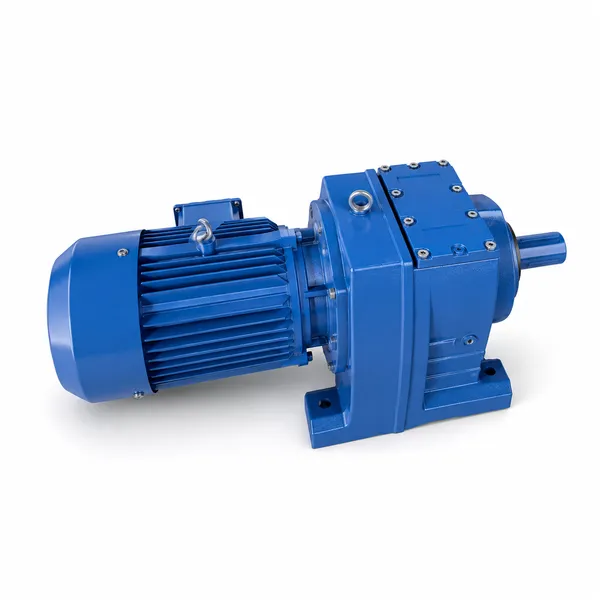
Korea Ever-Power NMRV worm gearmotors for agitator and mixer applications are available with either a solid output shaft for coupling to the agitator through a flexible coupling, or a hollow bore output for direct mounting onto the agitator shaft without a separate coupling. The hollow bore option is particularly useful for agitators mounted on the tank lid where the gearmotor must mount directly on the agitator shaft stub. All NMRV sizes accept either Y2 standard motor or Y2EJ brake motor input, with no modification to the gearbox. The complete gearmotor range is in the gearmotor product section. For high-viscosity agitator sizing above 2,000 cP, contact Korea Ever-Power for a complete agitator drive specification.
| Gearbox sizes | NMRV 030–090 |
| Ratio range | 15:1 to 100:1 |
| Impeller speed | 14–96 rpm (4-pole motor) |
| Motor options | Y2 or Y2EJ brake motor |
| Motor power | 0.06–22 kW |
| Self-locking | Yes at 40:1 and above |
| Output shaft | Solid or hollow bore |
| Mounting | Any orientation (specify) |
7. Agitator and Mixer Applications

Chemical Reactor and Vessel Agitator
Chemical process reactor agitators for reaction, dissolution, and crystallisation processes. NMRV 050–090 at 40:1 to 60:1 with Y2 0.37 to 7.5 kW. Product viscosity ranges from near-water to several thousand cP depending on reaction progress. For reactors handling flammable solvents (Zone 1 or Zone 2), the motor must be YB2 Ex d IIB T4 while the NMRV gearbox can be standard as it has no internal electrical components. Gearbox seal specification must match the solvent environment. |
Food and Beverage Mixer
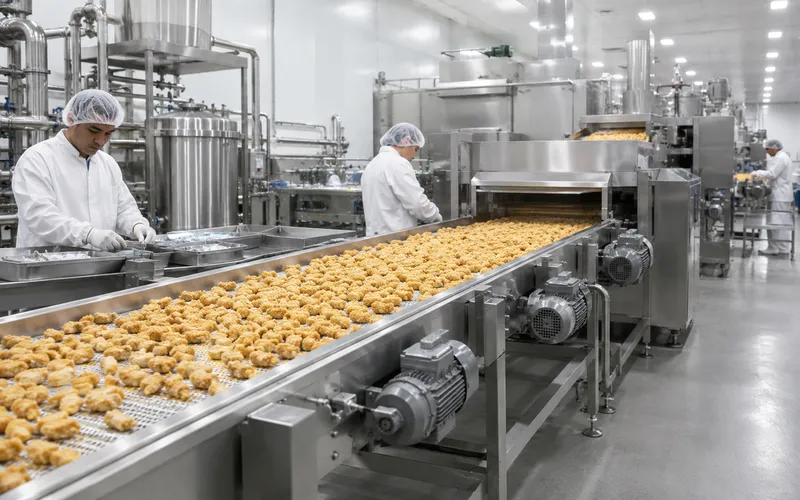
Industrial food mixers for sauce, jam, chocolate, dough, and cream products at 10 to 60 rpm. NMRV 050–075 at 20:1 to 100:1 with Y2 or BXG 0.25 to 2.2 kW depending on food contact zone classification. For washdown areas, specify BXG stainless motor with NMRV gearbox in food-grade oil fill. Self-locking at 40:1 and above holds paddle in position between batch cycles without motor power. |
Paint manufacturing dispersers, let-down agitators, and tinting base mixing tanks. NMRV 050–075 at 30:1 to 60:1, Y2 0.37 to 2.2 kW. Paint viscosity 500 to 10,000 cP — apply Kv 1.8 to 3.0. Many paint mixing applications also require Ex d motor in Zone 2 paint store areas.
Sedimentation tank agitators, slurry holding tank stirrers, and wastewater treatment aeration tank mixers. NMRV 075–090 at 15:1 to 30:1 for higher speed turbulent mixing in low-viscosity slurry. Y2 0.55 to 4.0 kW. IP55 for outdoor installation at wastewater treatment plants.
High-viscosity adhesive, epoxy resin, and potting compound mixing at 10 to 40 rpm. NMRV 075–090 at 40:1 to 100:1, Y2 0.55 to 2.2 kW. Very high starting torque required; specify 2.0 service factor for batch restart. Kv 3.0 to 4.0 for viscosities above 20,000 cP.
Small batch concrete mixers, mortar mixing stations, and tile adhesive preparation mixers. NMRV 075–090 at 20:1 to 40:1 with Y2 0.75 to 4.0 kW. High abrasion from aggregate — gearbox shaft seals must be heavy-duty felt or labyrinth type to exclude grit. IP55 for outdoor mixing site installation.

8. Frequently Asked Questions
Edited by Cxm