1. Winding Profile and Yarn Tension Control
The fundamental challenge of textile winding is that a package of yarn wound on a rotating spindle grows in diameter as yarn accumulates. If the spindle rotates at a constant speed, the yarn take-up speed (peripheral velocity of the package) increases proportionally to package diameter — causing the yarn tension to rise progressively and potentially causing yarn breakage, elongation, or package deformation on the outer layers of the package.
Full package diameter: D₂ = 250 mm
Fixed spindle speed: 1,000 rpm
Yarn speed at start: π × 0.05 × 1,000/60 = 2.62 m/s
Yarn speed at full: π × 0.25 × 1,000/60 = 13.1 m/s
Tension change: 5× increase from start to full → yarn breakage
At empty bobbin D₁ = 50 mm: n = 2.62 × 60 / (π × 0.05) = 1,000 rpm → 50 Hz
At full package D₂ = 250 mm: n = 2.62 × 60 / (π × 0.25) = 200 rpm → 10 Hz
VFD ramps from 50 Hz to 10 Hz as package builds
Tension constant throughout → perfect package quality
The VFD continuously decreases the motor frequency (and therefore spindle speed) as the package diameter increases, maintaining a constant yarn peripheral velocity and therefore constant tension. The package diameter can be calculated from a mathematical model of yarn layers, or measured directly by a proximity sensor or laser diameter measurement system that feeds a real-time signal to the VFD speed reference input.
2. Package Diameter Growth and Speed Ramp Calculation
The ratio of full package diameter to empty bobbin diameter determines the required VFD frequency range. For D₂/D₁ = 5 (as in the example above), the motor speed must range from rated speed (50 Hz) down to rated/5 = 10 Hz during the build. Most textile winding applications have D₂/D₁ ratios from 2:1 to 8:1, requiring VFD frequency ranges from 25 Hz to 6.25 Hz at the low-speed end of the package build. The YVF2 IC416 motor delivers full rated torque at 10 Hz and below — the IC416 blower maintains 100% cooling airflow regardless of VFD frequency. A standard IC411 motor would provide only 4% of rated cooling at 10 Hz — completely inadequate for the full torque demand at low package-build speed.
For the empty-bobbin start condition on a large package, the required spindle speed may be higher than the motor rated speed at 50 Hz. Operating the YVF2 above 50 Hz (field-weakening region) allows the motor to exceed its nameplate speed at reduced torque — acceptable for the empty bobbin phase where the winding tension load is lower. The YVF2 operates reliably to 120 Hz above-base, giving up to 2.4 times rated speed at reduced torque. Confirm with the textile machine manufacturer that the spindle bearing specification permits operation at the maximum extended speed.
3. Why Standard Motors Fail on Textile VFD Drives
At the full-package stage, the textile winding motor operates at 10 to 20% of its rated speed (5 to 10 Hz) while still producing close to rated torque to maintain yarn tension. A standard IC411 motor with shaft-mounted fan produces only 0.1 to 0.8% of rated cooling airflow at these speeds — essentially no cooling. The winding temperature rises rapidly above the Class F insulation limit, accelerating insulation ageing. A standard motor driving a textile winder at the full-package low-speed condition will fail within 6 to 18 months of service.
Textile machines often use long cable runs between the VFD cabinet and the individual spindle motors (10 to 30 m is common in a multi-position spinning frame where all spindles are driven individually). Long cable runs amplify the VFD PWM voltage spikes at the motor terminals through cable reflection effects, producing terminal voltages of 1,200 to 1,600 V. Standard motor winding insulation (Class F, standard varnish) fails progressively under this repeated voltage stress. The YVF2 Class H VFD-duty winding insulation is specifically formulated to resist PWM voltage spikes at these amplitudes.
The spinning room environment is heavily contaminated with airborne fibre fragments and fly (short fibres detached from the yarn). This fibre accumulates in motor ventilation slots, covers the cooling fins, and blocks cooling airflow. A standard IC411 motor in a spinning room will have its cooling fins blocked within weeks, raising frame temperature significantly. The YVF2 IC416 independent blower draws clean air from a pipe or duct rather than from the contaminated spinning room air, completely eliminating fibre contamination of the motor cooling system.
4. YVF2 Inverter-Duty Motor for Textile Winding
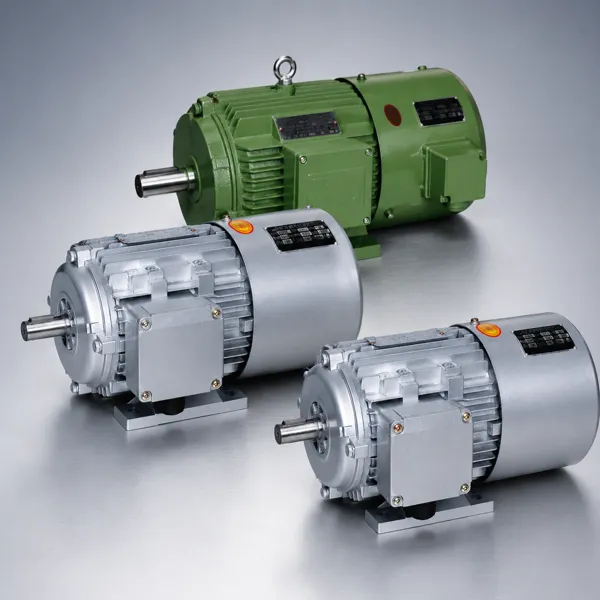
The Korea Ever-Power YVF2 with IC416 forced cooling resolves all three failure modes of standard motors on textile VFD drives: the independent blower provides 100% cooling at any speed from zero to 120 Hz; the Class H VFD-duty winding insulation resists PWM voltage spikes from long cable runs; and the independent blower draws clean cool air through a duct rather than recirculating fibre-contaminated spinning room air. PTC thermistors in the stator winding provide continuous winding temperature monitoring as a backup protection against any remaining thermal overload risk.
For spinning room applications where the IC416 blower must draw clean air rather than fibre-contaminated room air, the blower inlet can be connected to a small-bore duct (typically 50 to 80 mm diameter) that runs from the motor to a clean air source — either an external air supply plenum above the false ceiling, or a filtered air inlet box. This duct connection is a simple field modification to the IC416 blower housing and eliminates fibre ingestion into the blower impeller and motor cooling passage.
For textile machine installations with VFD-to-motor cable lengths above 15 m, specify a dV/dt filter on the VFD output to limit the rate of rise of the PWM voltage spikes reaching the motor terminals. This filter reduces the motor terminal voltage from 1,200 to 1,600 V to approximately 800 to 900 V, reducing the stress on the winding insulation and further extending the YVF2 service life in long-cable textile machine installations. The filter is installed at the VFD output terminals and is transparent to the VFD operation.
5. VFD Torque Mode vs Speed Mode for Winding
The VFD runs in speed control mode, and the speed reference is calculated from the current package diameter (measured or modelled) to maintain constant peripheral velocity. The yarn tension varies slightly due to any inaccuracy in the diameter calculation or model, but this variation is small and acceptable for most yarn types. Speed mode is simpler to configure and more stable in operation — it is the standard mode for most production textile winding machines. The YVF2 motor runs in V/Hz or sensorless vector control under speed mode.
For premium yarn types where even small tension variations cause visible fabric defects, the VFD can operate in closed-loop torque mode using a tension sensor (load cell on the yarn path) as the process variable. The VFD adjusts motor torque to maintain the tension sensor reading at the target set point, regardless of package diameter. This provides very tight tension control (± 2 to ± 5 grams on fine yarns) at the cost of higher control system complexity. The YVF2 supports torque mode operation with appropriate VFD motor parameter identification and closed-loop PID control configuration.
6. YVF2 Specifications for Textile Spinning and Winding
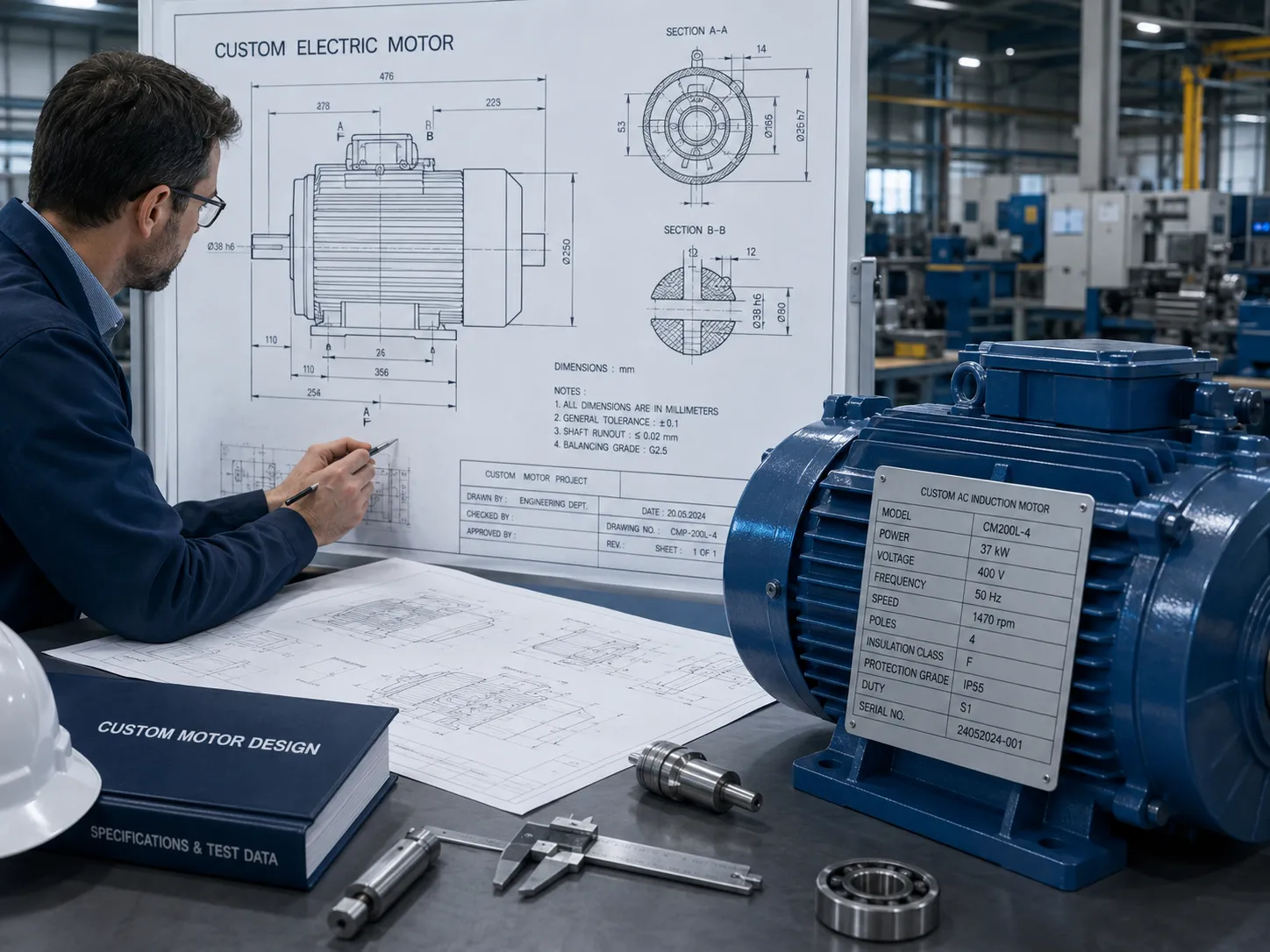
The Korea Ever-Power YVF2 series is the complete inverter-duty motor specification for textile spinning frames, winding machines, and yarn take-up systems requiring variable speed with constant tension from zero to rated speed and above. The IC416 independent blower, Class H VFD-duty insulation, PTC thermistors, and IEC 72-1 metric frame compatibility with the standard Y2 series make the YVF2 suitable for new textile machine designs and for retrofitting existing spinning frames and winders. The full YVF2 range is in the VFD motor product section. For multi-position spinning frame applications requiring multiple YVF2 motors on a common VFD bus, contact Korea Ever-Power for multi-motor VFD configuration guidance.
| Power range | 0.75–45 kW |
| Poles | 2P / 4P / 6P |
| Cooling | IC416 forced blower |
| Speed range | 0–120 Hz (0–3,600 rpm 2P) |
| Insulation | Class H, VFD-duty |
| Thermal protection | PTC thermistors standard |
| IP rating | IP54 |
| Blower duct | Available for clean air supply |
7. Textile Drive Applications
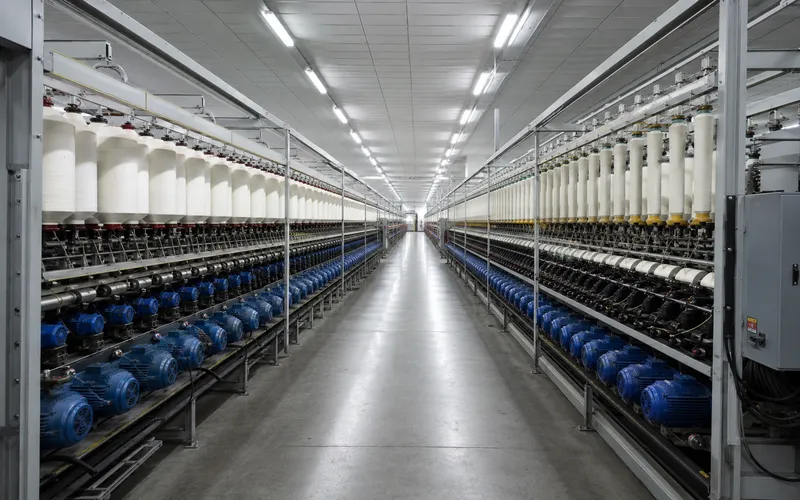
Ring Spinning Frame Drive
Ring spinning frames use a single main spindle shaft motor driving hundreds of spindles through long tangential flat belts or spindle tape. YVF2 2-pole 11 to 45 kW drives the main spindle shaft at variable speed from creep speed (for doffing) through full production speed. The VFD enables soft start to avoid yarn breakage on start-up, gradual speed ramp to production speed, and controlled slow-down at doff end. IC416 blower draws filtered air from above the machine frame to prevent fly accumulation in the motor cooling passage. |
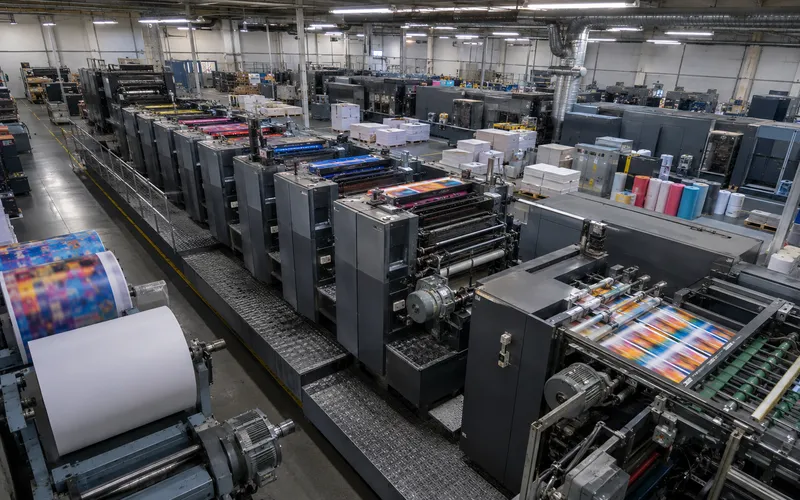
Cone Winding Machine
Automatic cone winding machines rewinding yarn from ring bobbins onto large cones use individually driven winding drums at 1,500 to 3,500 rpm. YVF2 2-pole 0.75 to 2.2 kW per winding position, with each position on a separate micro-VFD for independent tension control. The diameter-compensated speed algorithm ramps spindle speed down as cone grows to maintain constant yarn delivery speed. IC416 essential for the full cone build from empty spool to full cone across the 3:1 to 5:1 diameter ratio. |
Open-end (OE) rotor spinning machines run rotors at 80,000 to 150,000 rpm. The rotor is air-bearing driven and not motor driven, but the yarn take-up winding head uses a low-speed winding motor. YVF2 2-pole 0.75 to 1.5 kW per take-up head, VFD-controlled for package diameter compensation.
Sectional and direct warping machines wind parallel yarn sheets onto warp beams at 400 to 1,200 m/min. YVF2 2-pole 7.5 to 30 kW with VFD for beam speed control. Constant surface speed profile as beam builds from empty flange to full beam over 2:1 to 3:1 diameter ratio.
Positive feed yarn feeders on circular and flat knitting machines control yarn delivery tension to the needles. YVF2 2-pole 0.18 to 0.75 kW per feeder motor, running at adjustable speed set by the machine controller. Consistent yarn tension prevents dropped stitches and fabric faults.
Rope laying and closing machines require precise speed differential control between the stranding and closing heads. YVF2 2-pole 1.5 to 11 kW with separate VFDs on stranding and closing axes, with a speed ratio setpoint maintained by the machine controller. Constant tension prevents irregular rope lay and diameter variation.

8. Frequently Asked Questions
Edited by Cxm