1. Why Standard Motors Fail in Food Processing Environments
The operating environment in a food processing area is fundamentally hostile to standard industrial motors. Three mechanisms destroy conventional motors within months of installation in food zones, regardless of their IP rating or paint specification.
Food plant CIP (clean-in-place) circuits use sodium hypochlorite (NaOCl) at 150 to 500 ppm, peracetic acid at 0.1 to 0.2%, and caustic soda (NaOH) at pH 12 to 13. Cast iron motor frames corrode visibly within days of exposure to chlorinated cleaning agents. Painted aluminium frames lose their coating within weeks. Once the base metal is exposed, the corrosion accelerates, producing iron oxide (rust) or aluminium hydroxide particles that contaminate food products and create a documented food safety risk requiring regulatory action.
Standard motor frames have surface roughness values of Ra 3 to 12 μm from casting, machining, and painting processes. At Ra above 0.8 μm, bacterial cells find anchor points in surface irregularities that are protected from the shear force of even high-pressure cleaning jets. Listeria monocytogenes and Salmonella form biofilms in these surface pits that survive standard CIP cycles and recontaminate food products during subsequent production. EHEDG and 3-A Sanitary Standards require all food-contact-zone equipment surfaces to be Ra 0.8 μm or smoother, which eliminates standard motor frames from food area use entirely.
A motor running at operating temperature (frame surface 60 to 80°C) subjected to an 80°C hot water washdown followed by a cold water rinse at 10 to 15°C experiences thermal cycling of 50 to 70 K within minutes. Standard Class F insulation systems degrade from repeated thermal cycling because the differential thermal expansion between copper windings, iron core, and impregnation resin creates micro-cracks in the insulation. Class H insulation (180°C rated) is required for food-grade motors to withstand the thermal shock regime of a multiple-daily washdown operation over a 5 to 10 year service life.
EU Regulation (EC) 1935/2004 requires that all materials in contact with food, or likely to contact food through drip or splash, must not transfer components to food in quantities that endanger human health. USDA Accepted Equipment listing and NSF/ANSI 169 set equivalent requirements for North America. These regulations mean that a corroding cast iron motor mounted above a food conveyor is not a maintenance problem — it is a compliance failure that can trigger a production shutdown, product recall, or facility inspection.
2. SS316L vs SS304: Why the Steel Grade Matters
Not all stainless steel performs equally in food processing environments. The choice between SS304 (1.4301) and SS316L (1.4404) is determined by the chloride content of the cleaning chemicals and the ambient humidity at the installation site.
| Property | SS304 (1.4301) | SS316L (1.4404) |
|---|---|---|
| Key alloying elements | 18% Cr, 8% Ni | 18% Cr, 10% Ni, 2% Mo |
| Chloride resistance | Pitting above 200 ppm Cl⁻ | Resistant to 600+ ppm Cl⁻ |
| Pitting corrosion index (PRE) | ~18 | ~24 (Mo adds ~5 PRE points) |
| Crevice corrosion resistance | Moderate | Superior (Mo content) |
| EHEDG / 3-A acceptance | Accepted only in low-chloride applications | Preferred and specified for all food zones |
| Typical food industry use | Low-chloride bakery, dry storage, some dry powder handling | All wet food zones: meat, dairy, seafood, beverage, pharma |
The molybdenum content in 316L creates a more stable passive oxide layer that resists breakdown in the presence of chloride ions — the active agent in hypochlorite cleaning solutions. A 304 stainless steel motor in a dairy washdown area will show visible pitting corrosion on the frame surface within 12 to 24 months, compromising both the Ra 0.8 μm surface requirement and the long-term mechanical integrity of the enclosure. Korea Ever-Power specifies 316L as the only acceptable steel grade for all BXG series food-grade motors.
3. Surface Finish and Hygienic Design Principles
EHEDG (European Hygienic Engineering and Design Group) Document 8 defines the hygienic design principles for all equipment installed in food processing areas. For electric motors, the key requirements beyond IP69K and material grade are surface finish, drainage geometry, and elimination of dead zones where food residue or cleaning liquid can accumulate.
Achieved on BXG series by precision turning and grinding of all frame surfaces after casting and before assembly. The 0.8 μm limit is the threshold below which bacterial biofilm formation rate drops sharply — cells cannot achieve the stable initial surface contact needed to initiate biofilm in crevices below this roughness level.
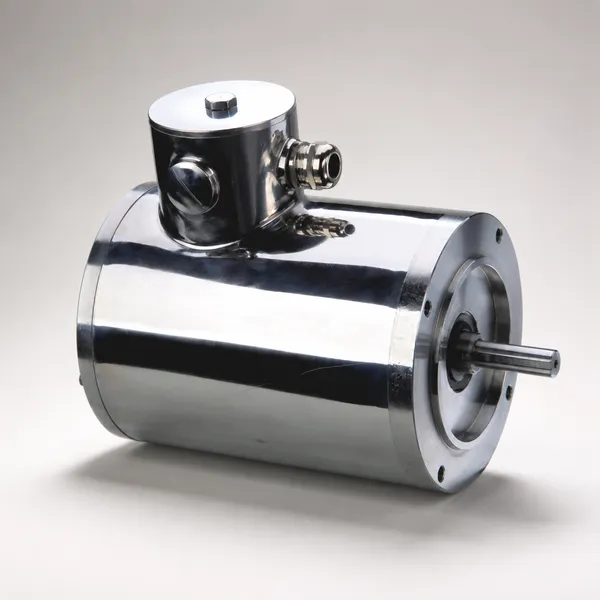
BXG series frame cooling fins are oriented at an angle to prevent water and food residue from pooling. The terminal box lid uses a convex profile rather than the flat lid standard on conventional motors. All external fastener recesses are minimised; socket head cap screws with smooth faces are used instead of cross-head or hexagonal recessed screws that trap food particles.
EHEDG requires that no pooled water remains on equipment surfaces more than 10 seconds after the end of a cleaning cycle. The BXG series frame profile is designed with drain angles on all horizontal-facing surfaces so cleaning water drains completely by gravity after the washdown is complete, preventing the residual moisture that would otherwise support bacterial growth between cleaning cycles.
4. The Complete Food-Grade Motor Specification
IP69K is a necessary condition but not sufficient on its own for food-grade use. The full specification for a stainless steel motor suitable for wet food processing areas requires all of the following simultaneously:
| Requirement | Standard Motor | BXG Food-Grade Motor | Regulatory Basis |
|---|---|---|---|
| Frame material | Cast iron / aluminium | AISI 316L full construction | EHEDG Doc.8; 3-A SSI 78 |
| Water protection | IP54 or IP55 typical | IP69K certified | IEC 60529; DIN 40050-9 |
| Surface roughness | Ra 3–12 μm (cast / painted) | Ra ≤ 0.8 μm all surfaces | EHEDG; EC 1935/2004 |
| Shaft seals | Nitrile rubber (non-FDA) | FDA silicone (21 CFR 177.2600) | FDA 21 CFR; NSF/ANSI 169 |
| Bearing grease | Industrial Li grease | NSF H1 food-grade | NSF International H1 |
| Insulation class | Class F (155°C) | Class H (180°C) | IEC 60034-1; thermal shock requirement |
| Shaft material | Carbon steel | 316L stainless steel | EHEDG; contamination prevention |
5. Korea Ever-Power BXG Series
The BXG series is Korea Ever-Power’s dedicated food-grade stainless steel motor range, available from the stainless steel motors product section. Every component that could make contact with the food processing environment — frame, end shields, fan cover, cooling fins, terminal box, all fasteners, shaft, and shaft seal — is manufactured from or coated with 316L stainless steel, finished to Ra 0.8 μm.
The BXG series uses a squirrel-cage induction motor platform sharing the same electrical design as the standard Y2 series, allowing direct performance substitution. The 2-pole (2,850 rpm) and 4-pole (1,440 rpm) pole configurations cover the speed range needed for most food processing conveyors, pump drives, agitators, and packaging line motors.
| Frame | AISI 316L stainless |
| IP rating | IP69K |
| Surface finish | Ra ≤ 0.8 μm |
| Insulation | Class H (180°C) |
| Shaft seals | FDA silicone |
| Grease | NSF H1 food-grade |
| Voltage | 380 V 50 Hz |
| Power range | 0.18–11 kW |
| Poles available | 2P (2,850 rpm) / 4P (1,440 rpm) |
6. Food Sector Applications
|
Meat and Poultry Processing
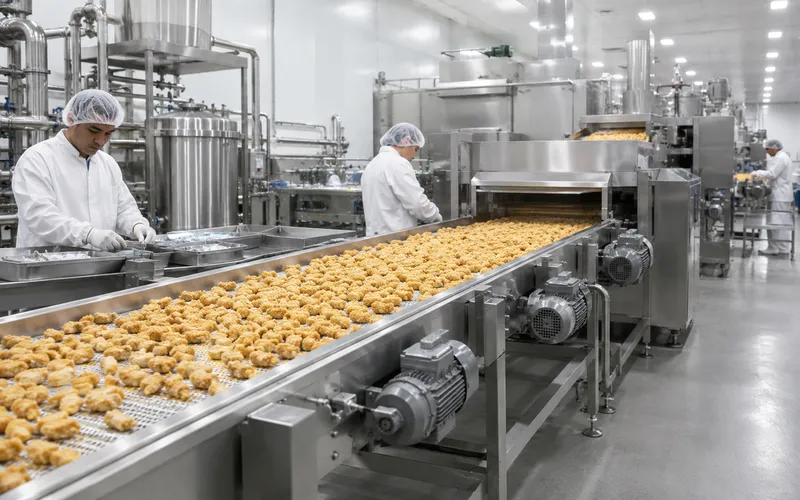
Conveyor drives, deboning table drives, and portion control line motors in red meat and poultry facilities are subject to multiple daily CIP cycles with NaOCl at 200 to 400 ppm and NaOH at pH 12. SS316L stainless steel motors with IP69K are the mandatory specification under USDA/FSIS and EU 853/2004 hygienic slaughter and processing regulations. The BXG series 4-pole models (1,440 rpm) paired with worm or helical reducers are the standard conveyor drive solution at 0.37 to 2.2 kW. |

Dairy and Beverage Production
Milk receiving, pasteurisation, filling, and packaging line motor drives in dairy and beverage plants operate in warm, humid environments where cleaning intervals can be as short as 4 to 6 hours. The SS316L BXG series provides the corrosion resistance needed for peracetic acid CIP at 0.1 to 0.2%, high-pressure hot water at 80°C, and steam cleaning at up to 100°C in cheese and yoghurt production areas. The 2-pole (2,850 rpm) BXG models are used for centrifugal pump drives and agitator drives in mixing vessels. |
Extreme Cl⁻ exposure from brine and gut acids. 316L preferred over 304 in all contact zones. BXG 0.37 to 1.5 kW 4-pole for filleting conveyor and washing drum drives.
Dough mixer and depositor drives in bread and pastry lines use BXG 0.75 to 5.5 kW models. Sugar and chocolate residue requires high-pressure hot water removal from motor surfaces.
API manufacturing mixing, granulation, and tablet coating line motors require GMP qualification documentation. BXG IP69K certification provides the third-party evidence for equipment validation packages.
Wort transfer pump, mash agitator, and fermentation vessel drive motors in breweries and distilleries. Hot water and steam CIP at brewing temperatures requires Class H insulation and IP69K.

7. Frequently Asked Questions
Edited by Cxm