- Supply is DC only (battery, solar, vehicle)
- Very low output speeds needed without a large gearbox
- Wide speed range from near-zero with simple PWM control
- Compact unit combining motor and reducer in one housing
- High starting torque at low speed is critical
- Three-phase or single-phase AC mains supply available
- Continuous duty at or near one fixed speed
- IE3 energy efficiency and low running cost are priorities
- Minimal maintenance for 20+ year service life
- Power range above 1 kW where DC becomes impractical
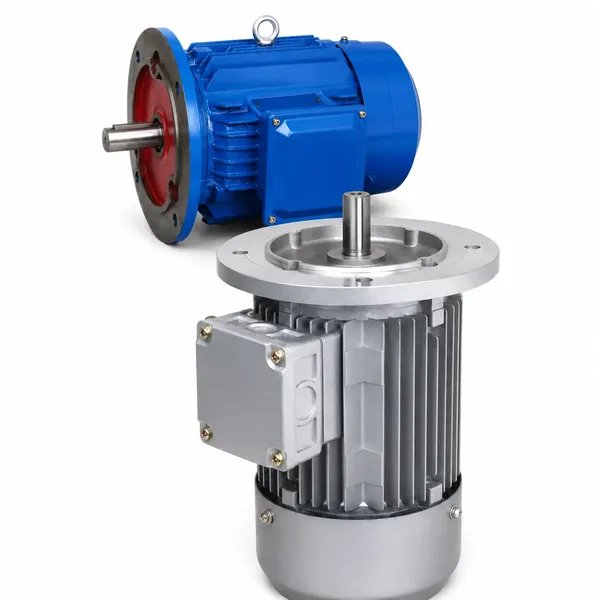
1. Fundamental Operating Differences
The DC gear motor and the AC induction motor convert electrical energy into rotational mechanical energy through entirely different electromagnetic mechanisms. Understanding these differences explains why each type has characteristic strengths and limitations that make it suited to different applications.
A DC motor creates torque through the interaction between current-carrying conductors in a rotating armature winding and a stationary magnetic field from permanent magnets or an electromagnetic field coil. The commutator and brush assembly reverse the current direction in each armature coil as it passes through the magnetic field, maintaining continuous rotation. Torque is directly proportional to armature current, and speed is proportional to the applied DC voltage minus the back-EMF. This linear relationship between current, voltage, and torque-speed output makes DC motors exceptionally easy to control with simple electronics.
A DC gear motor combines the DC motor with an integral reduction gearbox — typically a planetary or spur gear stage — in a single sealed housing. The gearbox multiplies the motor torque by the gear ratio while reducing the output shaft speed proportionally. Output speeds from 1 rpm to several hundred rpm are achievable without external gearing.
A three-phase AC induction motor generates a rotating magnetic field in the stator from three-phase sinusoidal currents in three sets of stator windings. This rotating field induces currents in the rotor conductors by electromagnetic induction, and the resulting force on the rotor conductors accelerates the rotor to just below synchronous speed. There is no physical electrical connection between the supply and the rotor — energy transfer is entirely through induction across a 0.2 to 0.5 mm air gap.
The absence of brushes, commutators, and slip rings in the squirrel-cage design eliminates all the wear mechanisms that limit DC motor service life. An AC induction motor has no consumable internal components beyond bearings, giving it a potential service life of 20 to 30 years in normal industrial conditions with bearing maintenance alone.
2. DC Gear Motor: Types and Characteristics
DC gear motors are categorised primarily by their field excitation method, which determines their torque-speed characteristic curve and their suitability for different types of speed control.
The most common type for power ranges up to approximately 5 kW. Stator field provided by permanent magnets — no field winding, no field current. Speed is approximately proportional to applied voltage; torque is proportional to armature current. Simple PWM speed control. Typical applications: robotics, automated guided vehicles, conveyors in battery-powered equipment, medical devices, and office automation. Temperature sensitivity: permanent magnet flux weakens at high operating temperatures, reducing torque output.
Field winding in series with armature; very high starting torque (up to 3–4× rated at standstill) but speed increases sharply with reduced load and can reach dangerously high levels at no-load. Must always operate with a connected load. Used in traction applications and large hoists where starting torque under full load is the primary requirement.
Permanent magnet rotor; electronic commutation replaces brushes and commutator. Combines DC torque characteristics and variable speed capability with AC motor longevity (no brush wear). Requires a dedicated BLDC controller. Increasingly used in precision positioning, medical equipment, and industrial automation where long maintenance-free life and precise speed control are both required.
| Brush service interval | 500–2,000 hours |
| Typical power range | 3 W – 5 kW practical |
| Speed control method | PWM voltage control |
| Efficiency (brushed) | 70–85% typical |
| EMI generation | High (brush sparking) |
3. AC Induction Motor: Reliability and Efficiency
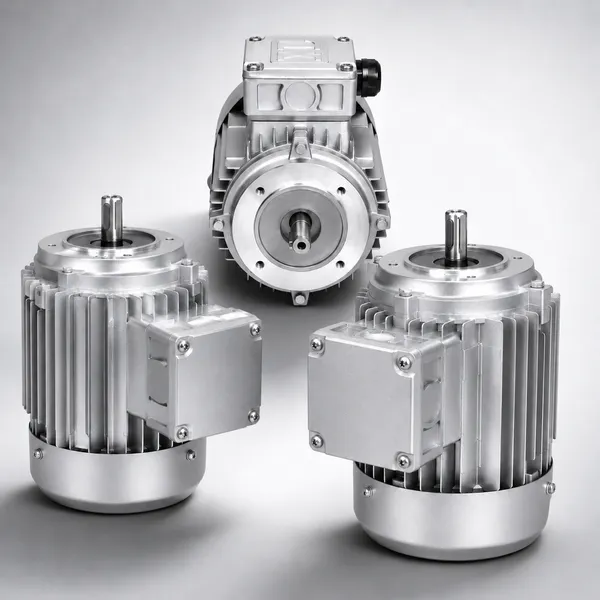
The squirrel-cage AC induction motor dominates industrial motor applications above approximately 0.75 kW because its brushless, contactless operating principle eliminates the primary failure modes that affect DC motors. The absence of brushes and commutator means no routine replacement of internal wear items — an AC induction motor running 8,000 hours per year in a normal industrial environment requires only bearing maintenance and periodic cleaning over a 20 to 30 year service life.
Korea Ever-Power Y2 series AC induction motors meet IE3 efficiency (88 to 95.8% depending on power rating) as standard. A comparable brushed DC gear motor at the same output power typically achieves 70 to 85% system efficiency when the gearbox losses and rectifier losses are included. At 5.5 kW and 4,000 hours per year, the AC induction motor IE3 vs DC gear motor efficiency difference amounts to 600 to 1,400 kWh per year — at $0.13/kWh, $78 to $182 annual energy saving per motor.
An AC induction motor paired with a variable frequency drive (VFD) achieves the same wide speed range as a DC gear motor with PWM control, but with higher system efficiency and no brush maintenance. The VFD-plus-AC-induction-motor combination has largely replaced brushed DC drives in new industrial installations above 1 kW. The Korea Ever-Power YVF2 inverter-duty series is engineered specifically for VFD operation with reinforced winding insulation and IC416 forced ventilation for full torque across the full speed range.
A brushed DC gear motor requires brush inspection and replacement every 500 to 2,000 operating hours, commutator cleaning and occasional re-machining, and gearbox oil changes every 2,000 to 4,000 hours. An AC induction motor with a separate gearbox requires only bearing regreasing every 4,000 to 8,000 hours (sealed bearings in smaller frames need no maintenance at all), terminal connection checks, and annual insulation resistance testing. In a facility running 8,000 hours per year, the AC motor requires 2 to 4 maintenance interventions per year versus 8 to 16 for a brushed DC gear motor at equivalent output.
4. Head-to-Head Comparison
| Parameter | DC Gear Motor (Brushed PMDC) | AC Induction Motor + Gearbox |
|---|---|---|
| Supply type | DC (battery, rectified mains, or PSU) | Three-phase or single-phase AC mains |
| Starting torque | Excellent (up to 3× rated at zero speed) | Good (1.8–3.0× rated at DOL start) |
| Speed range (variable) | Very wide: 0 to max with PWM | Wide with VFD (10:1 constant torque) |
| Efficiency (motor + drive) | 70–85% system efficiency | 88–96% motor (IE3); gearbox 90–98% |
| Maintenance interval | 500–2,000 h (brush replacement) | 4,000–8,000 h (bearing regreasing only) |
| Practical power range | 3 W – 5 kW (brushed); up to 10 kW (BLDC) | 0.12 kW – 1,000+ kW (unlimited) |
| EMI generation | High (brush arc; needs EMI filtering) | Low (sinusoidal; VFD adds some PWM EMI) |
| Unit size vs output | Compact (motor + gearbox integrated) | Larger (separate motor + gearbox or gearmotor) |
| Temperature sensitivity | PM flux weakens above 80–100°C | Stable up to Class F limit (155°C winding) |
| Typical service life | 3–8 years (brushed); 15+ years (BLDC) | 20–30 years with bearing maintenance |
5. Decision Matrix by Application
6. Korea Ever-Power Product Recommendations
Y2 series AC induction motor, 0.18–200 kW, IE3 standard, IP54. All four pole configurations. Paired with NMRV worm gearbox or helical reducer for low-speed applications.
YVF2 inverter-duty AC motor, 0.75–200 kW. IC416 external blower, Class H insulation, PTC thermistors. Replaces DC variable speed drives in most applications above 0.75 kW.
Gearmotor combinations: AC motor plus NMRV worm reducer or helical reducer in matched assemblies. Output speeds from 1.4 to 280 rpm. Directly comparable footprint to DC gear motor units above 0.12 kW.
YS series small power AC motor, 25–750 W. Aluminium frame, single-phase or three-phase. For applications where mains AC supply is available and DC gear motor would otherwise be specified at very small powers.

7. Frequently Asked Questions
Edited by Cxm