2. IEC Frame System Explained
3. NEMA Frame System Explained
4. IEC vs NEMA Dimension Comparison
5. Electrical Differences: Voltage, Frequency, Efficiency
6. Cross-Reference and Substitution Guide
7. Korea Ever-Power IEC Motor Range
8. Frequently Asked Questions
1. Why Two Parallel Motor Standards Exist
Electric motor standardisation developed independently on either side of the Atlantic during the early twentieth century. In the United States, the National Electrical Manufacturers Association (NEMA) published the first edition of its motor frame standard in the 1950s, establishing inch-based dimensions tied to the 60 Hz, 460 V North American power system. In Europe and the rest of the world, the International Electrotechnical Commission (IEC) developed an independent metric system tied to the 50 Hz, 380–400 V international power infrastructure.
Although both standards define the same basic set of dimensions — shaft height, shaft diameter, shaft extension length, foot hole spacing, and flange register diameter — they do so in different units with different numerical values, and they add different supplementary requirements for electrical performance, nameplate data, insulation testing, and efficiency classification. The result is that an IEC motor and a NEMA motor of nominally similar output power are not mechanically interchangeable without adapter plates or shaft machining, even when their frame designations might appear to be at similar positions in their respective series.
European Union, United Kingdom, Australia, New Zealand, India, China, Japan, South Korea, Southeast Asia, Middle East, Africa, South America. Covers approximately 85 percent of global new motor installations.
United States, Canada, Mexico, and some Latin American countries where North American electrical infrastructure is installed. Covers approximately 15 percent of global new motor installations.
2. IEC Frame System Explained
IEC 72-1 assigns frame designations using the shaft height (the distance in millimetres from the underside of the motor foot to the shaft centreline) as the primary identifier. This makes the shaft height immediately readable from the frame designation: an IEC frame 132 motor has a shaft height of 132 mm; frame 160 has shaft height 160 mm; frame 200 has shaft height 200 mm. Within each shaft height, a letter suffix indicates the stator core length: S (short), M (medium), or L (long). Longer core lengths accommodate larger winding volume and therefore higher power output at the same shaft height.
| IEC Frame | Shaft Height H (mm) | Shaft Dia. D (mm) | Foot Hole A (mm) | Foot Hole B (mm) | Typical Power (4P) |
|---|---|---|---|---|---|
| IEC 71 | 71 | 14 | 112 | 71 | 0.18–0.37 kW |
| IEC 80 | 80 | 19 | 125 | 100 | 0.37–0.75 kW |
| IEC 90 | 90 | 24 | 140 | 100 | 0.75–2.2 kW |
| IEC 100 | 100 | 28 | 160 | 112 | 2.2–3.0 kW |
| IEC 112 | 112 | 28 | 190 | 114 | 3.0–5.5 kW |
| IEC 132 | 132 | 38 | 216 | 140 | 5.5–11 kW |
| IEC 160 | 160 | 42 | 254 | 178 | 11–18.5 kW |
| IEC 180 | 180 | 48 | 279 | 203 | 18.5–30 kW |
| IEC 200 | 200 | 55 | 318 | 228 | 30–45 kW |
| IEC 225–315 | 225–315 | 60–85 | 356–508 | 254–406 | 45–200+ kW |
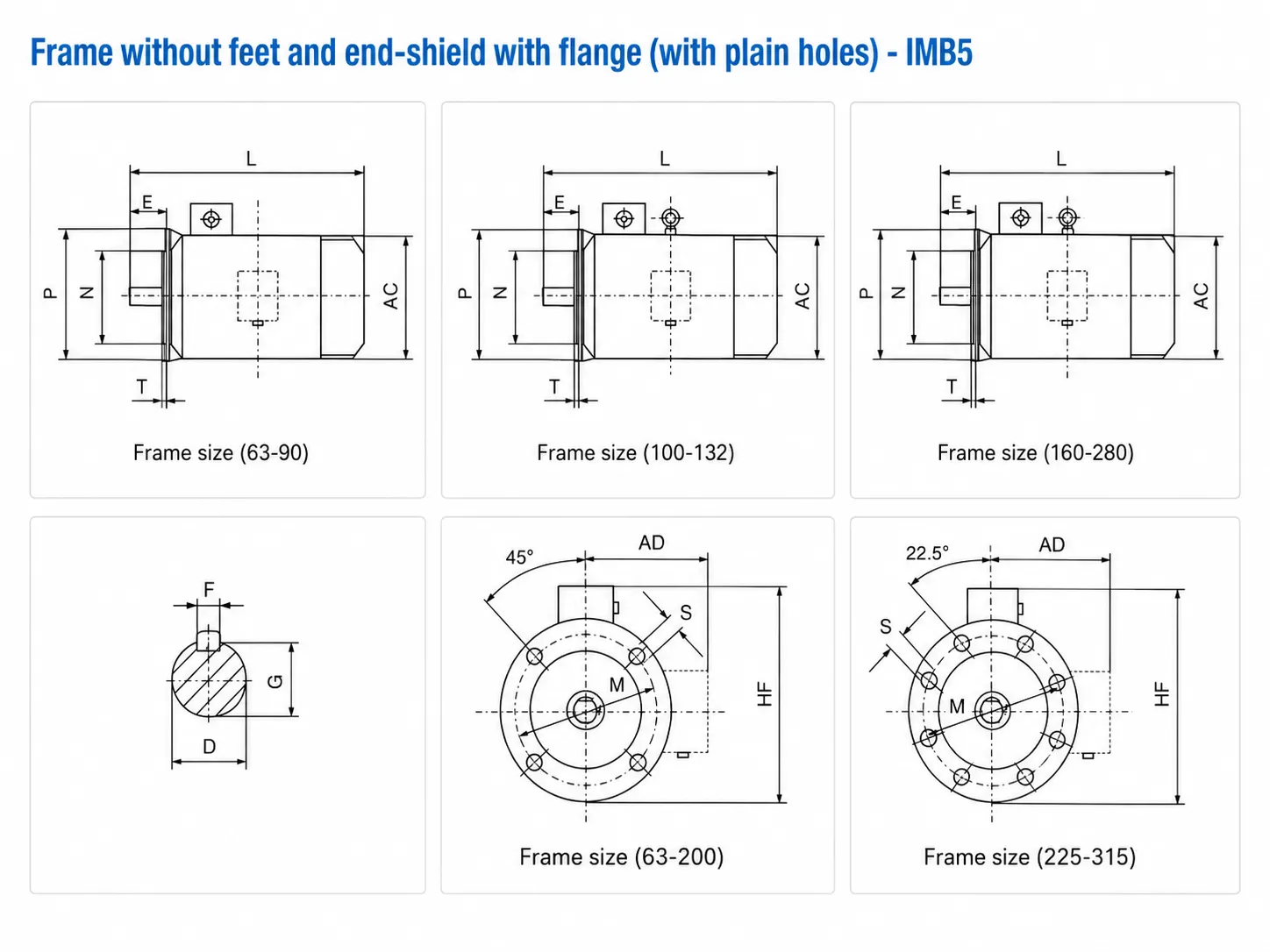
The IEC mounting code (IM designation) specifies the mounting arrangement: IM B3 (foot horizontal), IM B5 (flange horizontal), IM B35 (foot and flange), IM V1 (foot vertical shaft down), and so on. The same mounting code system applies across all IEC frame sizes and all manufacturers.
3. NEMA Frame System Explained
NEMA MG1 assigns frame numbers (such as 143T, 182T, 213T, 256T) where the first two or three digits encode the shaft height and the letter suffix indicates the T-frame series (the current standard since the 1960s) and mounting type. The shaft height in inches is calculated by dividing the first two digits of the frame number by 4: frame 143T has a shaft height of 14 ÷ 4 = 3.5 inches (88.9 mm); frame 256T has a shaft height of 25 ÷ 4 = 6.25 inches (158.8 mm). The third digit (3 in 143T, 6 in 256T) relates to the axial distance between the shaft end and the bolt hole pattern, not directly to the core length.
NEMA frame history note: before 1964, NEMA used U-frame designations (such as 143U) which are physically larger than the current T-frame for the same power rating. If replacing a U-frame motor, confirm whether the installed base uses T-frame or U-frame dimensions. Korea Ever-Power does not manufacture U-frame motors; all Y2 series motors are built to current IEC 72-1 dimensions which align more closely with T-frame than U-frame NEMA motors.
| NEMA Frame | Shaft Height (in) | Shaft Height (mm) | Shaft Dia. (in) | Typical Power (4P, 60 Hz) |
|---|---|---|---|---|
| NEMA 56 | 3.50 in | 88.9 | 5/8 in | ⅓–¾ hp |
| NEMA 143T | 3.50 in | 88.9 | 7/8 in | 1–1.5 hp |
| NEMA 182T | 4.50 in | 114.3 | 1⅛ in | 2–3 hp |
| NEMA 213T | 5.25 in | 133.4 | 1⅞ in | 5–7.5 hp |
| NEMA 256T | 6.25 in | 158.8 | 1⅝ in | 10–15 hp |
| NEMA 324T | 8.00 in | 203.2 | 2⅛ in | 20–30 hp |
| NEMA 365T | 9.00 in | 228.6 | 2⅞ in | 40–60 hp |
4. IEC vs NEMA Dimensional Comparison
The following table places comparable IEC and NEMA frames side by side, showing why the two systems are not dimensionally interchangeable even at nominally similar shaft heights. The shaft diameters, foot hole spacings, and shaft extension lengths all differ, meaning that an IEC motor cannot be directly bolted onto a NEMA motor mounting without modification.
| IEC Frame | IEC Shaft Ht (mm) | Nearest NEMA Frame | NEMA Shaft Ht (mm) | Shaft Ht Difference | Direct Bolt-On? |
|---|---|---|---|---|---|
| IEC 90 | 90 mm | NEMA 143T | 88.9 mm | −1.1 mm | No |
| IEC 112 | 112 mm | NEMA 182T | 114.3 mm | +2.3 mm | No |
| IEC 132 | 132 mm | NEMA 213T | 133.4 mm | +1.4 mm | No |
| IEC 160 | 160 mm | NEMA 256T | 158.8 mm | −1.2 mm | No |
| IEC 180 | 180 mm | NEMA 286T | 177.8 mm | −2.2 mm | No |
| IEC 200 | 200 mm | NEMA 324T | 203.2 mm | +3.2 mm | No |
Even where shaft heights are within 2 to 3 mm of each other, foot hole spacings (A and B dimensions) differ substantially between IEC and NEMA, and shaft diameters are specified in different tolerancing systems (metric h6 in IEC versus inch tolerances in NEMA). A direct bolt-on substitution of an IEC motor into a NEMA mounting or vice versa is not possible without machining work or an adapter plate.
5. Electrical Differences: Voltage, Frequency and Efficiency
IEC motors are rated for 380–400 V, 50 Hz three-phase supply (the standard across the IEC world). NEMA motors are rated for 460 V (or 230/460 V dual-voltage), 60 Hz three-phase supply (the North American standard). Running an IEC motor on 60 Hz supply increases synchronous speed by 20 percent (a 4-pole motor runs at 1,800 rpm instead of 1,500 rpm) and increases iron losses, requiring derating. Running a NEMA motor on 50 Hz supply reduces synchronous speed by 17 percent and may require re-rating. Dual-voltage NEMA motors (230/460 V, 60 Hz) cannot be simply connected to a 380 V, 50 Hz IEC supply without a frequency difference issue even when voltage is acceptable.
IEC motors are rated in kilowatts (kW). NEMA motors are rated in horsepower (hp). Conversion: 1 hp = 0.746 kW. Common cross-references: 1 hp ≈ 0.75 kW; 2 hp ≈ 1.5 kW; 5 hp ≈ 3.7 kW; 10 hp ≈ 7.5 kW; 20 hp ≈ 15 kW; 50 hp ≈ 37 kW. The IEC preferred power series (0.18, 0.25, 0.37, 0.55, 0.75, 1.1, 1.5, 2.2, 3.0, 4.0, 5.5, 7.5, 11 kW…) does not align exactly with the NEMA hp series (0.5, 0.75, 1.0, 1.5, 2.0, 3.0, 5.0, 7.5, 10… hp), so there is rarely an exact power-for-power substitution at the same frame size.
IEC motors use the international efficiency classification system (IE1 Standard, IE2 High, IE3 Premium, IE4 Super Premium) defined in IEC 60034-30-1. NEMA motors use a different classification scheme: NEMA Nominal Efficiency and NEMA Premium Efficiency (defined in NEMA MG1 Table 12-12). NEMA Premium Efficiency is approximately equivalent to IEC IE3 at most power ratings, though the test methods and specific efficiency values differ at some points in the range. The IEC and NEMA efficiency classes are not numerically interchangeable and should not be directly compared without consulting both standards.
6. Cross-Reference and Substitution Guide
Substituting an IEC motor for a NEMA motor (or vice versa) requires checking four things independently: shaft height (does it match the coupling or driven machine), foot hole pattern (does it match the baseplate), shaft diameter and extension length (does it fit the coupling or pulley), and electrical rating (does the motor work on the available supply). All four must be verified — a match on one or two dimensions is not sufficient for a successful substitution.
Measure the existing motor shaft height from the foot underside to shaft centreline. Find the IEC frame whose shaft height matches within ±2 mm to avoid a height difference at the coupling.
Measure A (longitudinal foot hole spacing) and B (lateral foot hole spacing) on the existing motor. Compare with the IEC frame A and B dimensions. If they differ, a new baseplate or adapter plate is needed.
The existing coupling bore or pulley bore must match the new motor shaft diameter. If not, bore the coupling or fit a shaft adapter sleeve. Shaft extension length must allow full coupling engagement.
Confirm the IEC replacement motor rated voltage and frequency match the available supply. For North American 460 V 60 Hz installations, specify a 460 V 60 Hz wound IEC motor or use a step-down transformer if using a standard 380 V 50 Hz IEC motor.
7. Korea Ever-Power IEC Motor Range
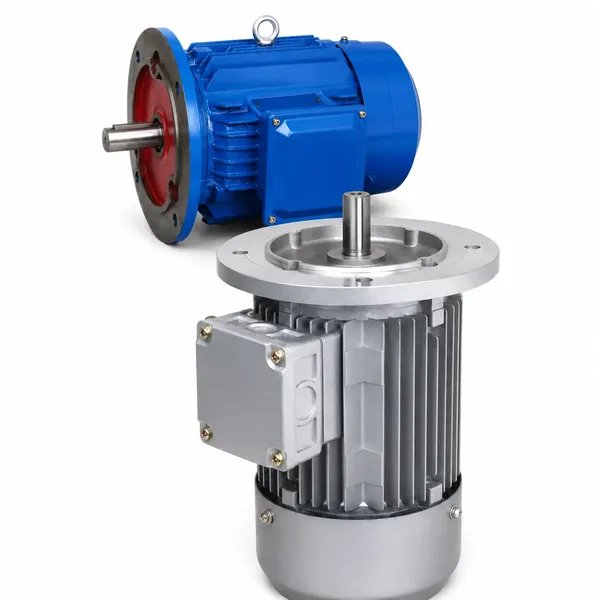
Korea Ever-Power manufactures all electric motors to IEC 72-1 metric frame standards. All Y2 series motors are dimensionally interchangeable with any IEC-compliant motor from any manufacturer at the same frame designation. The full three-phase motor range covers IEC frames 71 through 315 in 2-pole, 4-pole, 6-pole, and 8-pole configurations at 380 V 50 Hz as standard.



8. Frequently Asked Questions
Edited by Cxm