Korea Ever-Power · Maintenance Guide · Fault Diagnosis

How to Troubleshoot Electric Motor Failures:
10 Common Issues and Their Causes

Most electric motor failures give advance warning through measurable changes in current, vibration, temperature, or noise before the motor actually fails. Recognising these early signals and identifying their root cause accurately allows maintenance teams to correct problems before an unplanned shutdown. This guide covers the 10 most common electric motor troubleshooting issues found in three-phase induction motors, their diagnostic indicators, and the corrective actions that fix them.

Overheating
Bearing Failure
Vibration
Winding Insulation
Phase Loss

Issue 01
Motor will not start
Issue 02
Overheating
Issue 03
Excessive vibration
Issue 04
Noisy bearings
Issue 05
Phase current imbalance
Issue 06
Low insulation resistance
Issue 07
Motor runs slow
Issue 08
Reduced starting torque
Issue 09
Phase loss operation
Issue 10
Shaft seal leakage
Electric motor troubleshooting inspection testing phase current vibration Korea Ever-Power

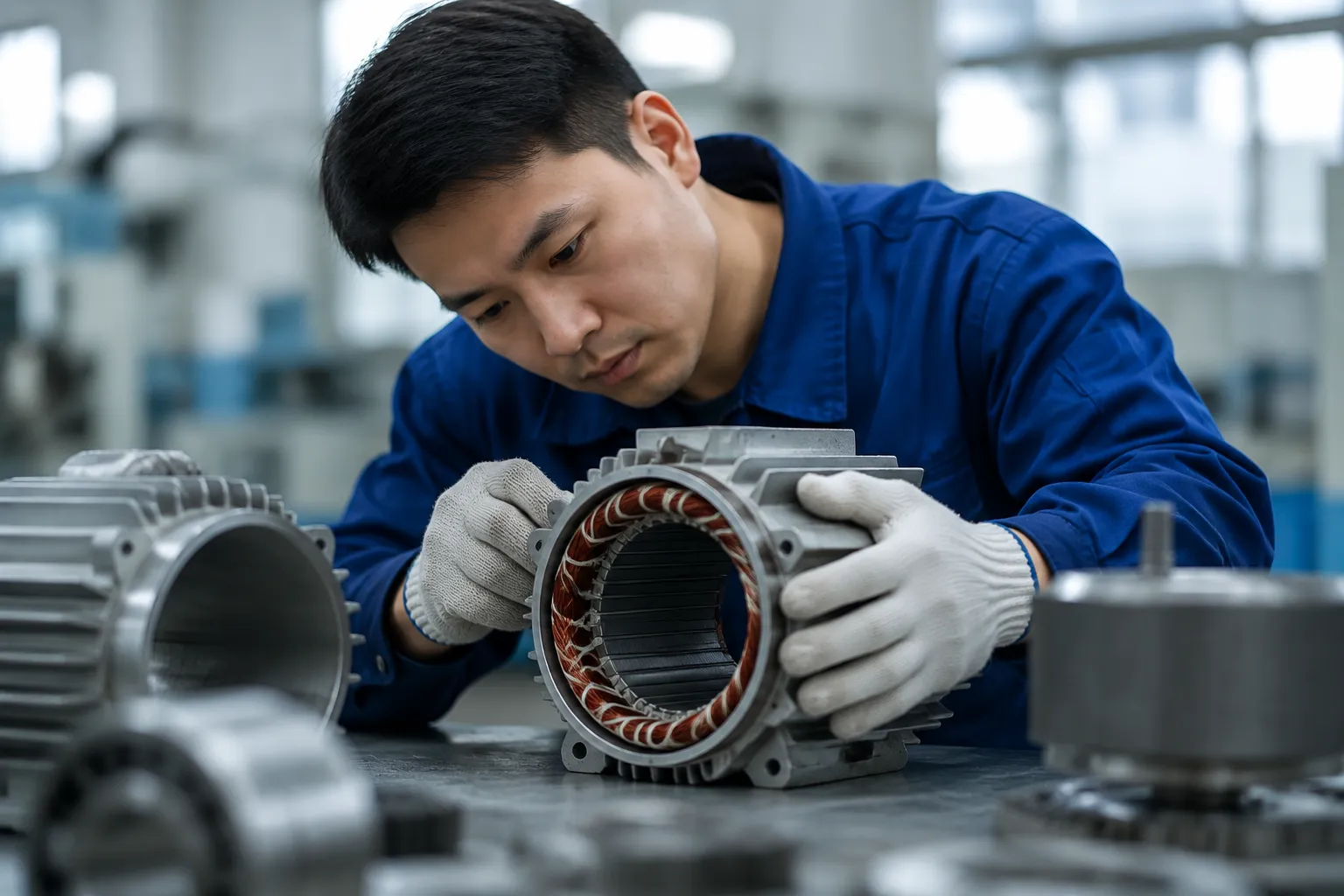
Quality inspection and testing — systematic measurement of current balance, insulation resistance, vibration, and bearing temperature at regular intervals is the most effective electric motor troubleshooting strategy, catching developing faults before they cause unplanned downtime.

Before You Troubleshoot

Before starting any electric motor troubleshooting work, isolate the motor from the electrical supply using the local disconnect switch and apply lockout/tagout (LOTO) procedure. Verify isolation with a voltage tester at the motor terminals. Allow the motor frame to cool to a safe touch temperature before working near the fan cover or terminal box. All measurements requiring motor operation should be performed with appropriate PPE and with the driven load secoupled where possible.

10 Common Electric Motor Problems and Their Solutions

01
Motor Will Not Start
Possible Causes
  • No supply voltage at motor terminals (blown fuse, open circuit breaker)
  • Incorrect terminal wiring (supply connected to wrong terminals)
  • Supply voltage too low to produce sufficient starting torque
  • Overload relay tripped and not reset
  • Seized bearing preventing shaft rotation
  • Driven load seized or locked mechanically
Diagnostic Steps

Measure supply voltage at motor terminals with motor in start command state. Confirm all three phases present and within 5% of rated voltage. Check overload relay status and reset if tripped. Try to rotate shaft by hand with supply isolated — resistance indicates mechanical seizure. Measure insulation resistance to rule out winding short circuit.

02
Overheating — Motor Frame Too Hot to Touch
Possible Causes
  • Motor overloaded beyond nameplate rating
  • Cooling fins blocked with dust or debris
  • Ambient temperature above rated maximum (typically 40°C)
  • Fan cover damaged, restricting airflow
  • Supply voltage imbalance causing unequal phase currents
  • Frequent starting cycles exceeding thermal capacity
Diagnostic Steps

Measure all three phase currents with clamp meter. If any current exceeds nameplate value, the load is too high. Measure supply phase-to-phase voltages — imbalance above 2% causes significant overheating. Clean cooling fins with compressed air. Measure ambient temperature at the motor air inlet. Check fan cover for obstruction or damage.

03
Excessive Vibration
Possible Causes
  • Shaft misalignment with driven machine
  • Unbalanced coupling or pulley
  • Loose hold-down bolts (motor or driven machine)
  • Worn or damaged bearings
  • Bent shaft from mechanical impact
  • Foundation resonance at running frequency
Diagnostic Steps

Measure vibration velocity at both bearing housings and at the baseplate. A vibration velocity above 2.8 mm/s RMS (IEC 60034-14 Grade A) requires investigation. If vibration reduces when load is disconnected, the driven machine or coupling is the likely source. Frequency spectrum analysis identifies the dominant frequency — 1x rpm indicates unbalance or misalignment; 2x rpm indicates angular misalignment or coupling issues.

04
Noisy Bearings — Grinding, Squealing, or Rumbling
Sound and Probable Cause
Intermittent grinding Hard particle contamination in grease
Continuous rumble Raceway spalling from fatigue or overload
High-pitched squeal Grease starvation or wrong grease type
Rhythmic clicking Ball or roller damage (flat spot)
Roughness at low speed VFD bearing current fluting
Corrective Action

Schedule bearing replacement at next planned maintenance window. For grease starvation: add correct grease type and quantity through grease nipple if fitted (re-greasable bearings only). For VFD current fluting: implement bearing current protection (insulated NDE bearing or shaft grounding brush). Do not continue running a motor with bearing damage beyond the next maintenance opportunity — a failed bearing can damage the stator bore through rotor contact.

05
Phase Current Imbalance
Cause Identification by Measurement

Measure phase-to-phase supply voltages at the motor terminals (not at the panel — voltage drop in cables can create imbalance that is invisible at the panel). Also measure all three phase currents under full load.

Voltage imbalance present → supply network problem; check transformer tap settings, check for high-resistance connections in switchgear

Voltage balanced, current imbalanced → motor winding fault; measure winding resistance on each phase — deviation above 2% indicates partial turn short or open circuit

Why Imbalance Is Damaging

A supply voltage imbalance of 3.5% can cause current imbalance of 15 to 25%, because induction motor current is highly sensitive to voltage asymmetry. The phase carrying the highest current heats most rapidly. NEMA MG1 and IEC 60034-26 recommend derating motor output power when voltage imbalance exceeds 1%. At 5% voltage imbalance, derate to 75% of nameplate power to avoid overheating of the hot phase winding.

06
Low Insulation Resistance — Below 1 MΩ
Possible Causes
  • Moisture absorption in winding from condensation or flooding
  • Insulation contamination with conductive dust, oil mist, or chemical vapour
  • Thermal degradation of insulation from repeated overheating
  • Mechanical damage to winding from impact or vibration
  • Partial discharge damage from VFD voltage spikes on standard motor
Corrective Action

First attempt drying: heat motor in oven at 80°C for 6 to 24 hours, or use winding heaters or a low voltage current injection. Retest insulation resistance after drying — if it recovers above 10 MΩ, moisture was the cause and the motor can be returned to service. If insulation resistance remains low after drying, the winding requires rewinding or motor replacement.

Minimum insulation resistance: 1 MΩ at 20°C. Rule of thumb: IR (MΩ) ≥ motor rated kV + 1

07
Motor Runs Below Rated Speed

Causes: Supply voltage below rated (reduces available torque, increasing slip at the same load); load torque exceeding motor rated output; a shorted turn in the rotor bar increasing rotor resistance and slip at full torque; single-phase operation from phase loss, which forces the motor to run on two phases with reduced torque capability and very high slip.

Check: Measure supply voltage under load (not no-load); measure current — if current is at or above nameplate but speed is low, the load exceeds motor rating. Measure rotor current signature for broken bar indication.

08
Reduced Starting Torque

Causes: Supply voltage at motor terminals below rated (starting torque is proportional to the square of voltage); wrong terminal connection (star used on a motor meant for delta on this supply); broken rotor bar reducing rotor current at starting; star-delta starter not switching correctly and leaving motor in star at rated load.

Check: Measure voltage at motor terminals during start attempt. Verify terminal connection (star vs delta) matches motor rating. A locked-rotor current test (short-time only) reveals if rotor current is below expected value, suggesting broken bars.

09
Phase Loss — One Phase Lost During Running

Symptoms: Motor continues running on two phases but at reduced torque and very high current in the remaining two phases. Hum increases significantly. Frame temperature rises rapidly. Overload relay should trip within 1 to 3 minutes if correctly set.

Causes: Blown fuse on one phase, open contact in a contactor, broken supply cable, loose terminal connection. Action: Isolate immediately — continued running on single-phase will destroy the winding. Check all three phase fuses and contactor contacts. Measure continuity of each supply phase to motor terminals.

10
Shaft Seal Leakage

Symptoms: Grease or oil tracks visible on the shaft extension, motor frame around the drive-end seal, or on the driven machine mounting face. In food-grade or IP69K motor applications, seal failure is a hygiene risk as well as a maintenance issue.

Causes: Seal lip worn from abrasive contamination; seal aged beyond service life; excessive radial load or shaft deflection damaging seal lip contact; grease over-filled causing pressure buildup behind the seal. Action: Replace shaft seal with correct type — standard nitrile or food-grade silicone (BXG series). Address the root cause (load or lubrication) to prevent recurrence.

Quick Diagnostic Reference

Symptom Observed First Measurement Likely Root Cause Corrective Action
High frame temperature Phase currents Overload or voltage imbalance Reduce load; check supply balance
Vibration increase Vibration spectrum Misalignment (1x or 2x rpm dominant) Re-align; check coupling
Bearing noise (rumble) Bearing temperature Fatigue, contamination, or VFD fluting Replace bearing; add bearing protection
Current imbalance >5% Phase voltages Supply imbalance or winding fault Correct supply; rewind if winding
Insulation R < 1 MΩ 500 V megohmmeter Moisture, contamination, or ageing Dry out; rewind if persistent
Speed below rated Voltage under load Low voltage or overloaded Correct voltage; reduce load

Korea Ever-Power rotor production motor factory

Rotor Production

Korea Ever-Power engineering team motor support

Engineering Team

Industrial electric motor mining conveyor application

Mining Applications

Korea Ever-Power global shipping export

Global Support

Frequently Asked Questions

How often should insulation resistance be measured as part of a motor maintenance programme?

For motors in continuous service in standard industrial environments, measure insulation resistance annually as a minimum. In harsh environments (high humidity, chemical exposure, high ambient temperature, or frequent thermal cycling), measure every 6 months. Record the value with the motor temperature at the time of measurement, as insulation resistance approximately halves for every 10°C rise in temperature — a value of 5 MΩ at 50°C is equivalent to approximately 80 MΩ at 20°C. A declining trend over several measurements is more significant than a single absolute value, indicating progressive insulation degradation.

Is it safe to restart a motor that has tripped on overload without investigating the cause?

No. An overload trip means the motor protection relay detected current above the set threshold for long enough to trigger the thermal model in the relay. Simply resetting and restarting without investigation risks a repeat trip (if the cause is a persistent overload) or, worse, allows a motor that is already hot from the first trip to restart and reach damaging winding temperatures faster in the second overload event. Before resetting an overload relay, wait for the motor to cool, identify and correct the cause of the overload, verify the overload relay is set to the correct current (matching the nameplate), and check that the three phase currents are balanced.

When should I replace a motor rather than repair it?

Replacement is generally more cost-effective than repair when: the motor is below 11 kW (repair cost approaches new motor cost); the motor is IE1 or IE2 efficiency (replacement with IE3 provides ongoing energy cost savings that quickly recoup the capital cost); the motor has been rewound more than once (each rewind reduces efficiency and thermal capacity); or the motor has suffered severe damage (burnt stator bore, bent shaft, or flooded winding). Repair is justified for large motors (above 30 kW) with repairable damage — a rewound 90 kW motor at quality rewind shop standards remains serviceable and cost-effective versus a new motor purchase. Korea Ever-Power can supply replacement motors for all major frame sizes from the standard Y2 and specialist series — enquire through the technical support team.


Korea Ever-Power · Technical Support

Need Replacement Motors or Technical Support?

Korea Ever-Power holds stock of Y2, YB2, Y2EJ, YVF2, and BXG series motors across all standard IEC frame sizes for fast replacement. Technical enquiries for troubleshooting assistance are welcome.

View Replacement Motors

Edited by Cxm