1. Conveyor Drive Power Calculation
The required drive motor power for a belt conveyor is calculated from the effective belt tension and the belt speed. The effective tension is the net horizontal force that the drive pulley must apply to the belt to move the load at the required speed — it accounts for the weight of material on the belt, the belt mass, idler rolling resistance, and any elevation change.
F = 0.022 × 40 × 9.81 × (10+8) + 8 × 9.81 × 3/40 = 155.6 + 5.9 = 161.5 N
P = 161.5 × 1.2 ÷ (1,000 × 0.94) = 0.21 kW → select 0.37 kW motor
| Conveyor Type | Typical Friction Factor f | Belt Speed Range | Typical Motor Range |
|---|---|---|---|
| Light parcel / warehouse | 0.020–0.025 | 0.5–1.5 m/s | 0.18–1.5 kW |
| Food processing conveyor | 0.022–0.030 | 0.1–0.5 m/s | 0.37–3.0 kW |
| Aggregate / quarry | 0.025–0.035 | 1.0–2.5 m/s | 3.0–30 kW |
| Mining (coal / ore) | 0.030–0.040 | 1.5–4.0 m/s | 11–200 kW |
| Inclined (elevation lift) | 0.025–0.035 + sinθ | 0.5–2.0 m/s | 2.2–75 kW |
2. Starting Torque Requirements
A belt conveyor that starts under load — with material already on the belt — imposes a higher torque demand on the motor during the acceleration phase than during steady-state running. The starting torque requirement depends on whether the conveyor starts empty, under partial load, or under full load, and whether the start is direct-on-line (DOL), star-delta, or via a soft-starter.
Starting torque requirement 1.0–1.2× rated running torque. Y2 series DOL starting torque of 2.0–2.8× rated is more than adequate. No special consideration needed — standard Y2 motor with standard overload relay is the correct specification.
Starting torque requirement 1.5–2.0× rated running torque for a normally loaded belt, up to 2.5× for a steep incline with full load. Confirm Y2 motor locked-rotor torque (typically 2.2–2.8× rated) exceeds the worst-case loaded start requirement with 15% margin.
Star-delta starting reduces starting current to one-third but also reduces starting torque to one-third — inadequate for loaded conveyor starts. Soft-starter provides adjustable ramp torque with reduced starting current, suitable for long or heavy belt conveyors. Always verify the soft-starter output torque at ramp start is above the conveyor running torque.
Starting current note: Y2 series motors have a locked-rotor current (Ist) of 6.0–7.5× rated current during DOL starting. For long belt conveyors above 15 kW on DOL, verify that the supply cable and upstream fuses can carry this 3–8 second inrush without voltage drop below 85% of rated voltage at the motor terminals. Voltage drop below 85% during starting reduces available starting torque by the square of the voltage ratio and may prevent the conveyor from accelerating under load.
3. Motor Sizing with Service Factor
The calculated drive power from Section 1 is the theoretical continuous running power under normal conditions. The motor selected must be rated above this calculated power by a service factor that accounts for overloads, conveyor belt tension variability, belt sag under wet or frozen conditions, starting frequency, and component wear over the motor’s service life.
Uniform, well-controlled load; clean indoor environment; infrequent starts; short conveyor (below 30 m). Warehouse parcel conveyors, food tray conveyors, light assembly line belt conveyors. Motor rated at 1.0× calculated power is acceptable. Select next standard kW above calculated.
Moderate load variation; occasional overloading; outdoor or dusty environment; 5–20 starts per hour. General industrial conveyors: aggregate handling, packaging line infeed, recycling plant belt. Motor selected at 1.15× calculated power, then rounded up to next standard kW.
High load variation; frequent starting; heavy or abrasive material; inclined conveyor. Mining conveyors, aggregate with lump material, coal handling, inclined belt above 15 degrees. Motor selected at 1.25× calculated power, rounded up to next standard kW in the Y2 series.
4. Speed Selection: 4-Pole vs 6-Pole for Conveyor
The pole count of the motor determines its synchronous speed (at 50 Hz: 2-pole = 3,000 rpm, 4-pole = 1,500 rpm, 6-pole = 1,000 rpm, 8-pole = 750 rpm) and therefore the gearbox ratio required to reach the target belt speed. The choice between 4-pole and 6-pole directly affects the gearbox size, cost, and the system efficiency.
The 4-pole (1,450 rpm) Y2 motor is the standard conveyor drive motor for belt speeds of 0.5 to 2.5 m/s when paired with a gearbox or NMRV worm reducer. At belt speed 1.0 m/s with a 100 mm drive pulley radius, the required output speed is 1.0 ÷ (2×π×0.1) = 1.59 rev/s = 95.5 rpm — a 1,450 ÷ 95.5 = 15.2:1 gear ratio, well within the NMRV single-stage range.
Where the required belt speed is below 0.5 m/s and a single-stage gearbox would need a ratio above 80:1, specifying a 6-pole motor (960 rpm) reduces the required gear ratio by one-third, allowing a smaller gearbox. Food processing inspection belts, dough handling lines, and slow assembly conveyors typically specify 6-pole motors to avoid dual-stage gearboxes.
5. Duty Cycle and Thermal Rating
The motor runs continuously at constant load long enough to reach thermal equilibrium. Most production conveyors, mining conveyors, and warehouse logistics belts running single or multi-shift operation are S1 duty. S1 is the standard duty class for Y2 series motors. The nameplate power rating is the maximum continuous output at full rated voltage and 40°C ambient.
The motor runs for defined periods (cycle on time) then rests (cycle off time) repeatedly. Conveyors that index product (run–stop–run) rather than running continuously fall into S3 duty. The duty factor (on time as a percentage of total cycle time) determines whether a smaller motor can be used — at 40% duty factor, a motor can be used at approximately 115% of its S1 continuous power rating.
Y2 series motors are rated at 40°C maximum ambient. Conveyors installed in foundries, near furnaces, or in hot climates above 40°C must derate the motor output by approximately 1% per degree above 40°C. A 5.5 kW Y2 motor in a 55°C ambient derate to 5.5 × (1–0.15) = 4.68 kW effective capacity and must be sized accordingly.
6. Korea Ever-Power Y2 Series for Conveyor Drives
The Korea Ever-Power Y2 series three-phase induction motor is the standard specification for belt conveyor drives across the 0.18 to 200 kW power range. All Y2 motors meet IE3 premium efficiency as standard, reducing energy cost on continuously running conveyor drives. The full range is available in the three-phase motor product section.
For conveyor drives requiring a combined motor and gearbox unit, Korea Ever-Power supplies Y2 motors matched and assembled with NMRV worm gear reducers or R/F/K series helical reducers as complete gearmotor assemblies, available in the gearmotor combination section.
| Power range | 0.18–200 kW |
| Poles | 2P / 4P / 6P / 8P |
| Efficiency | IE3 standard |
| Protection | IP54 standard; IP55 option |
| Insulation | Class F, Class B rise |
| Voltage | 380 V 50 Hz standard |
| Frame | IEC 71–315 |
| Starting torque | 2.0–2.8× rated |
7. Conveyor Applications by Sector
Mining and Aggregate Conveyor
Coal handling, ore transfer, and aggregate screening conveyors use Y2 series 4-pole motors in the 7.5 to 75 kW range, typically with IP55 protection for outdoor installation. Starting method is soft-starter for long belts above 30 m and DOL for short in-plant conveyors. Service factor 1.25 is standard for abrasive material conveying. Motor mounted with separate helical or bevel-helical gearbox for the high torque ratios required at 1.0 to 3.0 m/s belt speeds with 200 to 800 mm drive pulleys. |
Food Processing and Packaging Conveyor
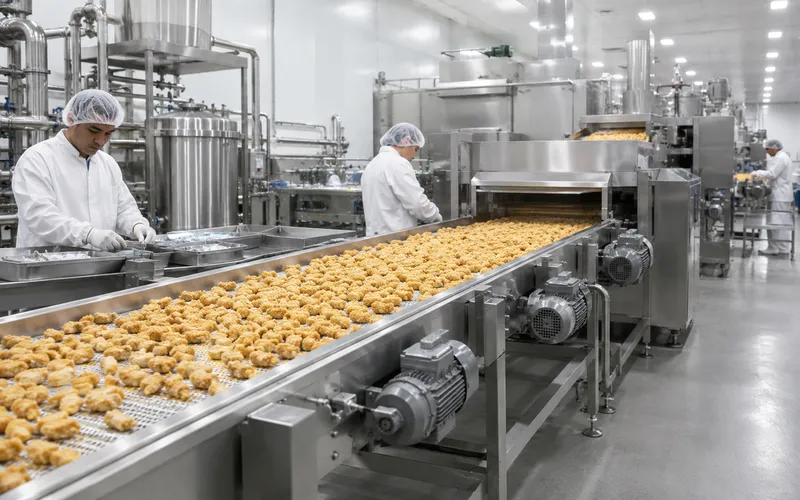
Food conveyor drives use Y2 series 4-pole and 6-pole motors in the 0.37 to 5.5 kW range at slow belt speeds of 0.05 to 0.5 m/s. NMRV worm gearmotor combinations provide the required low output speeds in a compact right-angle package. Where washdown is required, the BXG stainless steel motor replaces the standard Y2 for motors in wet zones. IP54 Y2 motors are suitable for dry food handling areas. All food conveyor motors should be IE3 to minimise the energy cost of continuous operation over 20-year plant life. |
Parcel and tote conveyors in distribution centres use 0.18 to 1.5 kW Y2 motors paired with NMRV 040–063 gearmotors. Accumulation zones use Y2EJ brake motors for precise zone stopping without stopping adjacent zones. IE3 efficiency is critical at scale — 500 conveyor motors at 0.37 kW for 6,000 h/yr, IE3 vs IE2, saves approximately 4,500 kWh/yr.
Inclined belts at angles above 10 degrees require anti-rollback to prevent load sliding back when the motor stops. NMRV worm gearmotor at 40:1 or above provides passive self-locking. For steeper inclines or safety-critical applications, Y2EJ brake motor with spring-applied brake is the correct specification.
Conveyors in chemical plants and powder handling areas where explosive dust or vapour atmospheres exist require YB2 explosion-proof motors in place of standard Y2. Gas group and temperature class must be matched to the specific materials present. IP55 standard on YB2 covers outdoor chemical plant installation.
Airport baggage conveyors and check-in belts use Y2 4-pole 0.75 to 3.0 kW motors at belt speeds of 0.5 to 1.0 m/s with NMRV or drum motor drive. High daily start-stop frequency may qualify as S4 duty — confirm the motor thermal rating covers the actual duty cycle before specifying.


8. Frequently Asked Questions
Edited by Cxm