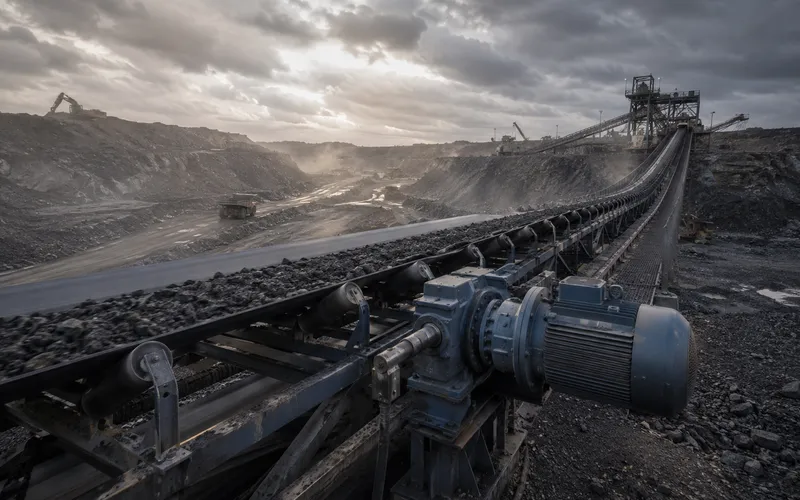
1. Mining Conveyor Load Characteristics
Mining conveyor loads differ from general industrial conveyor loads in three important ways: the material bulk density is much higher (coal 800 kg/m³, iron ore 1,800–2,600 kg/m³, aggregate 1,400–1,800 kg/m³), the belt is typically inclined (5 to 18 degrees for underground and surface mine conveyors), and the load variation is significant as the mine feed rate changes with the excavation cycle. These factors require a higher service factor and more robust motor selection than equivalent-length industrial conveyors.
The static component of the belt tension on an inclined belt is the weight of all material on the belt × sin(incline angle). At 15-degree incline with 2,000 kg of coal on a 50-metre belt, the static belt pull force from elevation alone is 2,000 × 9.81 × sin(15°) = 5,080 N. This static load must be overcome before the belt can move — and it must be held by the drive torque during a momentary stop at full load to prevent rollback. The motor must produce sufficient locked-rotor torque to accelerate the belt against this static tension from standstill.
Mining material loading onto the belt at the feed point can vary from zero to maximum rated throughput as the loading equipment (excavator, truck, feeder) cycles. A motor sized for average load will be periodically overloaded as the peak load pulse passes the belt. The service factor accounts for this variation — for coal handling with a rotary breaker or vibrating feeder feeding the belt, a service factor of 1.25 provides adequate reserve for the peak load spikes typical of intermittent bulk material feeding.
The tight-side belt tension (carrying side) and the slack-side belt tension differ substantially on a loaded inclined belt. The ratio between them (the wrap factor, dependent on drive pulley diameter, belt wrap angle, and coefficient of friction) determines the minimum belt pre-tension required to prevent belt slip on the drive pulley under maximum motor torque. A correct belt tension design prevents both slip under full torque and belt overstress under locked-rotor starting torque.
2. Starting Torque for Loaded Inclined Belt
Starting a loaded inclined belt conveyor from rest requires overcoming the static belt load plus the rolling resistance and belt bending resistance of the entire belt length simultaneously. The motor must produce adequate starting torque to accelerate the belt from standstill to full speed within an acceptable acceleration time, against the sum of all resistive forces at their maximum values.
where K-start = 1.5 to 2.5 for loaded inclined belts
For 15-degree incline at full load, K-start ≈ 2.2 to 2.8
For most mining conveyor starting conditions, Y2 LR torque is adequate for DOL starting on belts up to 30 m length. For longer belts, soft-start is required to control the belt tension transient.
3. Soft-Starter vs DOL for Long Mining Belts
Direct-on-line starting is acceptable for mining conveyors below approximately 30 m in length where the elastic belt stretch during acceleration does not cause significant tension wave propagation. The belt stiffness on short conveyors is high relative to the belt length, so the entire belt accelerates approximately as a rigid body. Starting current 6 to 7.5 times rated must be accommodated by the supply cable and upstream switchgear. Y2 series 11 to 45 kW motors on DOL starting with a correctly sized overload relay provide reliable repeated starting performance.
For long mining conveyors above 30 m, a DOL start generates a belt tension wave that travels from the drive end to the tail end and reflects back, potentially exceeding the belt breaking strength or the drive pulley friction coefficient. A soft-starter ramps the motor voltage over a 5 to 15 second period, slowly increasing belt tension without generating dynamic tension waves. The soft-start ramp time is set to produce a controlled belt acceleration of 0.05 to 0.15 m/s² from belt speed zero to full rated speed, regardless of the magnitude of the starting current or the belt load condition at the time of starting.
| Belt Length | Recommended Start Method | Ramp Time | Reason |
|---|---|---|---|
| Below 30 m | DOL | N/A | Belt short enough to start as near-rigid body; no tension wave issue |
| 30–100 m | Soft-starter | 5–10 s | Moderate tension wave risk; soft-start prevents belt slip and tension overshoot |
| 100–500 m | Soft-starter | 10–30 s | Significant elastic belt stretch; long ramp prevents tension wave and belt damage |
| Above 500 m | VFD + YVF2 motor | 30–120 s | Very long belt requires precise controlled ramp; VFD gives full torque control throughout |
4. Motor Power Calculation for Mining Conveyor
Incline angle θ = 12°
Belt speed v = 1.5 m/s
Capacity = 300 t/h = 55.6 kg/s
Material density ρ = 850 kg/m³ (coal)
Friction factor f = 0.030
Belt mass m-b = 8 kg/m
Drive efficiency η = 0.92
Service factor SF = 1.25
Friction tension: F-f = 0.030 × 80 × 9.81 × (2×8 + 37.1) = 1,405 N
Lift tension: F-h = 37.1 × 9.81 × 80 × sin(12°) = 6,075 N
Total tension: F = 1,405 + 6,075 = 7,480 N
Motor power: P = 7,480 × 1.5 ÷ (1,000 × 0.92) = 12.2 kW
With SF 1.25: 12.2 × 1.25 = 15.3 kW
→ Select Y2-180M-4, 18.5 kW, IP55, IE3
5. IP55 for Outdoor Mining and Dusty Environments
Surface mine conveyors are typically exposed to direct rainfall, wind-driven dust and grit, and occasional water flooding from storm events. IP55 provides dust-protection (not dust-tight) and protection against water jets, which is sufficient for outdoor installation in areas not subject to sustained high-pressure water exposure. Korea Ever-Power Y2 series with IP55 option covers all standard surface mine conveyor motor requirements. The heavy cast iron construction of frames above IEC 160 also provides excellent mechanical protection against the impact of lump material that may fall off the belt.
Underground mine conveyors operate in high humidity environments (often 90 to 100% RH) with continuous fine coal dust or stone dust deposition on all surfaces. IP55 provides adequate protection for the electrical enclosure. However, the motor insulation resistance should be checked more frequently in underground installations — annually as a minimum — because the combination of high humidity and coal dust contamination degrades insulation resistance faster than in surface environments. In underground coal mines where methane may be present, the entire conveyor drive including the motor must comply with the applicable underground mining equipment certification for flammable gas risk.
Many mining operations are at elevation — South American copper mines at 3,000 to 4,000 m, African gold mines at 2,000 m, and Australian iron ore operations at 500 to 800 m. At altitude above 1,000 m, air density decreases and motor cooling by convection becomes less effective. IEC 60034-1 requires derating of approximately 1% per 100 m above 1,000 m altitude. At 3,000 m altitude, derate motor output by 20% — a nominally 55 kW Y2 motor at 3,000 m altitude should be treated as a 44 kW motor for sizing purposes.
6. Korea Ever-Power Y2 Series for Mining Conveyor
The Korea Ever-Power Y2 series in IEC frames 132 through 315 covers the 5.5 to 200 kW power range required for most surface and underground mining conveyor drives. The 4-pole (1,450 rpm) configuration is the standard for mining conveyor drives — paired with a helical or bevel-helical gearbox through a fluid coupling or soft-starter on the motor side. For very long overland conveyors above 500 m length, Korea Ever-Power recommends the YVF2 inverter-duty motor with a VFD for full speed and torque control throughout the starting ramp. The complete Y2 range is available in the three-phase motor product section. Contact the Korea Ever-Power technical team for large mining conveyor motor specifications above 75 kW.
| Power range | 5.5–200 kW typical |
| Poles | 4P (1,450 rpm) standard |
| Efficiency | IE3 standard |
| Protection | IP55 for outdoor mining |
| Starting torque | 2.0–2.8× rated (DOL) |
| Service factor | 1.25 for mining conveyors |
| Duty | S1 continuous |
| Start method | Soft-starter above 30 m belt |
7. Mining Conveyor Applications
Primary ROM coal conveyor from underground to surface. Heavy lump coal at 0 to 300 mm, capacity 500 to 2,000 t/h, belt speed 1.5 to 3.5 m/s. Y2 4-pole 18.5 to 90 kW, IP55, soft-start. Service factor 1.25 for variable feed from continuous miner or longwall shearer. Helical-bevel gearbox with fluid coupling preferred for smooth start.
Stockpile stacker conveyor handling wet iron ore fines at 1,800 to 2,600 kg/m³ bulk density. High static incline load. Y2 4-pole 30 to 160 kW, IP55, soft-starter with 10 to 30 s ramp. Heavy duty cast iron frame above IEC 250 for lump impact resistance on direct feed from crusher.
Aggregate transfer between crusher, screen, and stockpile. Y2 4-pole 7.5 to 45 kW, IP55. Moderate dust, occasional rain. Belt speeds 1.0 to 2.5 m/s. Service factor 1.25 for crushed stone with lump size up to 150 mm. DOL start if belt below 30 m; soft-starter for longer transfer belts.
Underground limestone haulage conveyor in high-humidity environment with fine dust deposition. Y2 4-pole 11 to 55 kW, IP55. Annual insulation resistance testing critical. Non-coal underground mining does not typically require the methane explosion-proof certification required in coal mines, but confirm local underground mining regulations before specifying standard Y2 motors underground.
8. Frequently Asked Questions
Edited by Cxm