1. Roller Conveyor Types and Zone Drive Architecture
Roller conveyors fall into two broad categories based on the driving principle: gravity roller conveyors where product slides downhill under gravity without any motor, and powered roller conveyors where motors rotate the rollers to transport product on level or inclined surfaces. Powered roller conveyors use several different driving architectures depending on the product weight and the accumulation requirement.
A single motor drives a line shaft running the full length of the conveyor. Individual rollers are driven from the line shaft through round belts or O-rings. The slip between the O-ring and the roller allows accumulation — when a product stops, the O-ring slips on the stationary roller. Line shaft drives use a single Y2 motor of 0.37 to 2.2 kW per 10 to 20 m section, with the motor output coupled to the line shaft through a small gearbox or directly. This is the simplest and lowest cost roller conveyor drive architecture for light to medium loads.
A separate motor drives each accumulation zone (1 to 5 m long) of the conveyor. Each zone motor is independently controlled by the conveyor zone controller, which can stop a zone when a product is waiting or when the downstream zone is blocked. Zone drive enables zero-pressure accumulation — products stop with zero contact force between them, preventing product damage in accumulation mode. Zone drive requires one Y2 motor (0.12 to 1.5 kW typically) and one gearbox per zone, making it more complex and expensive than line shaft but providing superior accumulation control.
Motorised rollers integrate a small DC or three-phase motor inside the roller tube itself, with adjacent rollers driven by a flat polyurethane belt from the motorised roller. Each motorised roller covers a 1 to 3 roller zone. This is the most compact architecture — there is no external motor or gearbox — but it is limited to lighter loads (below 100 kg per product). Korea Ever-Power Y2 motors are used in external zone drives as an alternative to motorised rollers for heavier pallet conveyor applications above 100 kg per unit load.
2. Zone Motor Power Calculation
Zone length: L = 2.0 m (6 rollers at 333 mm pitch)
Roller friction factor: μ = 0.05 (steel roller on steel shaft)
Roller diameter: d = 76 mm
Shaft diameter: 20 mm
Conveyor speed: v = 0.3 m/s
Drive efficiency η = 0.85
F = 500 × 9.81 × 0.05 × (20÷76) = 64.5 N
Motor power: P = F × v ÷ η = 64.5 × 0.3 ÷ 0.85 = 22.8 W
With service factor 1.15 for accumulation: 26.2 W
Selecting per zone: Y2 0.12 kW (120 W) 4-pole, IEC 71
(Standard motor size above calculated power)
For pallet conveyors handling loads above 500 kg, heavy roller bearings with higher friction (μ = 0.08 to 0.12), or conveyors with inclines, recalculate using the actual friction and incline force components. Standard zone motor sizes for roller conveyor applications are 0.12, 0.18, 0.25, 0.37, and 0.55 kW for most pallet and carton conveyor applications. Motors above 0.75 kW per zone indicate either a very heavy load, high speed, or steep incline that should be reviewed against the specific conveyor design.
3. Accumulation Mode and Motor Thermal Rating
In accumulation mode, a stopped zone motor continues to spin the drive rollers while the product on top of the zone is stationary — the product slides on the rollers or the torque limiter between the motor and rollers slips to prevent motor overload. However, if the zone drive is a direct-coupled gearmotor without slip, the motor stalls against the stationary product and draws locked-rotor current, which rapidly overheats the motor winding.
In a properly designed zero-pressure accumulation system, the zone motor is stopped when the zone sensor detects a product waiting and the downstream zone is occupied. The zone motor drives an empty zone and stops with the zone when a product is detected — there is no product accumulation against a running drive. Under these conditions, the zone motor operates at S3 intermittent duty with typical CDF of 40 to 60% — the Y2 motor thermal rating is not challenged because the motor stops cleanly when the zone stops. This is the correct approach and eliminates accumulation stall heating entirely.
In older or simpler roller conveyor systems using line shaft drives with O-ring slip, or zone drives with torque-limiting couplings, the motor continues to run while the product is stationary above a running zone. In this case the motor runs at no-load (if the rollers are slipping on the product), or runs at stall current if the product is gripping the rollers. For stall-mode accumulation, the motor must be rated for S1 continuous at rated torque AND must have an overload relay correctly set for motor stall protection. Apply service factor 1.25 to 1.5 for stall-capable accumulation drives to provide adequate thermal margin.
4. Conveyor Speed and Drive Gearbox Selection
| Conveyor Application | Belt Speed | Roller Diameter | Required Roller rpm | Gearbox Ratio (4P) |
|---|---|---|---|---|
| Slow pallet accumulation | 0.1 m/s | 108 mm | 18 rpm | 80:1 |
| Standard pallet conveyor | 0.3 m/s | 108 mm | 53 rpm | 27:1 |
| Fast pallet transfer | 0.5 m/s | 108 mm | 88 rpm | 16:1 |
| Carton conveyor (standard) | 0.5 m/s | 50 mm | 191 rpm | 7.6:1 |
| High-speed sorting conveyor | 1.5 m/s | 60 mm | 477 rpm | 3:1 |
For pallet roller conveyors at standard 0.3 m/s speed, the required roller rpm of 53 at a 108 mm roller diameter is achieved with a helical inline gearbox at approximately 27:1 ratio. Korea Ever-Power R series inline helical gearboxes in the 0.37 to 2.2 kW range are compatible with the Y2 IEC 71 to 100 frame motors and provide ratios from 3.7:1 to 185:1 — covering the full speed range of industrial roller conveyor applications. For very slow accumulation at 0.1 m/s, the 80:1 ratio falls within the NMRV worm gearbox range, making the NMRV a compact alternative to the helical gearbox for slow pallet accumulation zones.
5. Compact Mounting Within the Conveyor Frame
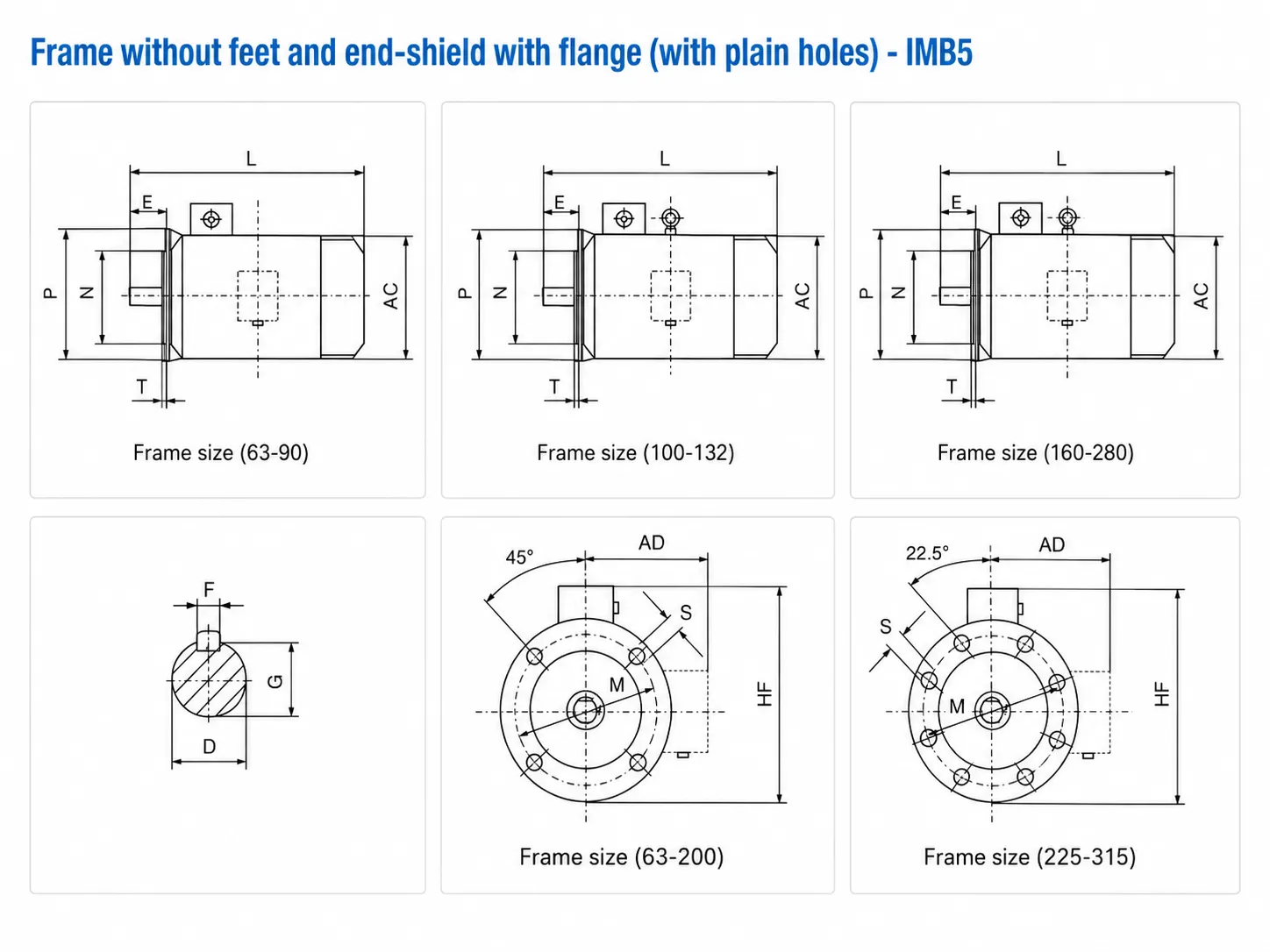
The zone drive motor and gearbox must fit within the lateral envelope of the conveyor frame, typically 600 to 1,200 mm wide for a pallet conveyor. The motor is normally mounted below the conveyor frame between the two side rails. Korea Ever-Power Y2 motors in IEC 71 (shaft height 71 mm) to IEC 100 (shaft height 100 mm) are compact enough to fit within standard pallet conveyor frame widths when mounted with the shaft axis parallel to the conveyor travel direction. Confirm the motor frame dimensions against the available space in the conveyor design before specifying the motor frame size.
When the motor must be mounted with its shaft axis perpendicular to the roller axis (for example, in a narrow conveyor where the motor must be installed between adjacent rollers from the side), a bevel-helical gearbox provides the 90-degree angle change at high efficiency (92 to 96%) while keeping the overall drive unit compact. Korea Ever-Power K series bevel-helical gearboxes with IEC B5 input flange connect directly to the Y2 motor and provide right-angle output at ratios from 8.1:1 to 176:1 — ideal for roller conveyor zone drives requiring right-angle mounting.
Standard industrial roller conveyor motors in warehouse and distribution centre environments only require IP54 protection — the environment is clean and dry. IP55 is recommended for conveyors in wet areas such as cold store dock levellers, beverage factory inbound and outbound conveyors, or outdoor covered dock areas where rain splash is possible. Washdown conveyors in food processing areas require BXG IP69K stainless steel motors rather than standard Y2 motors.
6. Korea Ever-Power Y2 Series for Roller Conveyor Drives
The Korea Ever-Power Y2 series in compact IEC 71 to 132 frames covers the 0.12 to 5.5 kW range required for roller conveyor zone drives, line shaft drives, and accumulation conveyor motors. The 4-pole Y2 at 1,450 rpm is the standard configuration for all roller conveyor zone drive applications — paired with inline helical, right-angle bevel-helical, or NMRV worm gearboxes depending on the layout and speed requirement. For conveyor systems requiring zone VFD speed control, specify the YVF2 inverter-duty motor in place of the standard Y2 for reliable operation across the full zone speed range. The complete Y2 range is in the three-phase motor section. Contact Korea Ever-Power for conveyor zone drive motor and gearbox package selection.
| Power range | 0.12–5.5 kW |
| Frame sizes | IEC 71, 80, 90, 100, 112, 132 |
| Standard poles | 4-pole (1,450 rpm) |
| Efficiency | IE3 |
| IP rating | IP54 standard |
| Service factor | 1.15 (accumulation) |
| Gearbox option | R inline / K bevel / NMRV |
| Duty | S1 / S3 depending on zone control |
7. Roller Conveyor Applications

Pallet Accumulation Conveyor
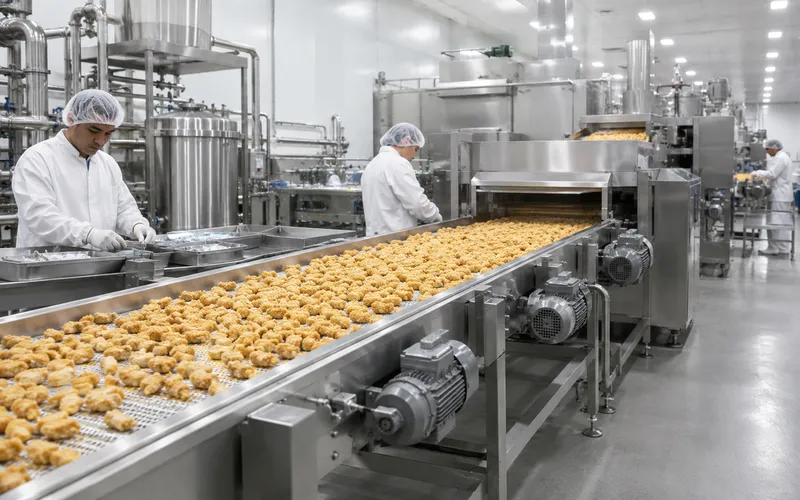
Pallet conveyor systems in distribution centres, manufacturing plants, and cold stores use zone-drive roller conveyors for pallet transport, accumulation at docking stations, and transfer to AS/RS infeed. Y2 0.12 to 0.55 kW per zone, 4-pole, paired with inline helical gearbox at 20:1 to 80:1 for 0.1 to 0.3 m/s pallet speed. Zero-pressure accumulation control through zone photocell sensors and zone motor starters managed by conveyor PLC. |
Carton Sortation Conveyor
High-speed carton sortation systems in e-commerce fulfilment and postal sorting use roller conveyors at 0.5 to 1.5 m/s with short zone drive motors at 0.12 to 0.37 kW, 4-pole. At high throughput (3,000 to 10,000 cartons/hour), the zone start-stop cycling approaches the Y2 motor thermal limit — specify S3 40% duty and confirm motor starting frequency against the Y2 maximum starts per hour specification before ordering. |
Single Y2 0.37 to 2.2 kW per 10 to 20 m line shaft section driving all rollers through O-rings. Simple and reliable for continuous non-accumulation transport. Common in manufacturing lines where products move at constant flow. Service factor 1.0 for non-accumulation service.
Roller conveyors in freezer stores (-25 to -18°C) for pallet and tote transport. Y2 0.12 to 0.55 kW, 4-pole, IP55. Low-temperature bearing grease required. Class F insulation on stator winding confirmed for cold ambient. Specify cold store option when ordering.
Powered roller tracks in automotive and electronics assembly carry work carriers (jigged pallets or trolleys) between assembly stations. Y2 0.12 to 0.37 kW per zone, 4-pole, paired with right-angle bevel-helical gearbox for compact installation between track rails. Zone control stops carrier at each assembly station.
Inclined roller conveyors at 5 to 15 degrees for level change between conveyor sections. Y2 0.18 to 1.1 kW per zone depending on incline angle, load weight, and zone length. Apply incline gravity force component: F-incline = W × g × sin(angle). For steep inclines, anti-rollback backstop or Y2EJ brake motor required.

8. Frequently Asked Questions
Edited by Cxm