Electromagnetic Brake Motors – YEJ Series Three-Phase Motor with DC Disc Brake
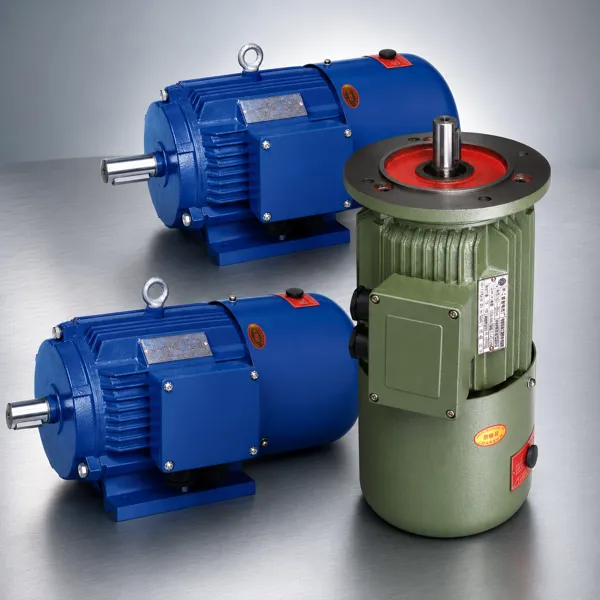
YEJ/Y2EJ Series Electromagnetic Brake Motor Overview
The YEJ series electromagnetic brake motor is derived from the Y2 series three-phase induction motor with an integrated DC electromagnetic disc brake assembly mounted on the non-drive end (NDE). When AC power is supplied to the motor, a built-in rectifier energizes the brake coil, creating an electromagnetic force that pulls the armature plate away from the brake disc against spring pressure. The brake releases and the motor runs freely.
When power is disconnected, the electromagnetic field collapses and compression springs immediately push the armature plate against the brake disc, applying friction torque that brings the rotor to a complete stop. This fail-safe spring-applied, electrically-released design ensures the motor stops and holds position even during power failure, making it suitable for vertical lifting applications where load slippage could cause injury or equipment damage.
Our brake motors are manufactured with the same stator and rotor technology as our standard three-phase induction motors, ensuring consistent electrical performance while adding the braking function. The brake mechanism adds only 50–80 mm to the overall motor length depending on frame size.
Technical Specifications
The following table lists the key engineering parameters for our YEJ/Y2EJ electromagnetic brake motor series. All electrical values are at 380V, 50Hz rated conditions.
| Parameter | Specification |
|---|---|
| Motor Series | YEJ (IE2), Y2EJ (IE2/IE3 available) |
| Power Range | 0.12 kW – 55 kW (0.16 HP – 75 HP) |
| IEC Frame Sizes | 63M, 71M, 80M, 90S/L, 100L, 112M, 132S/M, 160M/L, 180M/L, 200L, 225S/M, 250M |
| Number of Poles | 2-pole (2800 rpm), 4-pole (1400 rpm), 6-pole (930 rpm), 8-pole (690 rpm) |
| Rated Voltage | 380V (standard), 400V, 415V, 440V, 460V available |
| Rated Frequency | 50Hz (standard), 60Hz available |
| Brake Type | DC electromagnetic disc brake, spring-applied / electrically-released (fail-safe) |
| Brake Voltage | DC 99V (frame 71–100), DC 170V (frame 112–250), via built-in AC/DC rectifier |
| Static Brake Torque Range | 2.4 N·m (frame 63) to 280 N·m (frame 250) |
| Braking Response Time | ≤ 0.1 seconds (power-off to full stop, no load) |
| Brake Release Time | ≤ 0.15 seconds (power-on to brake fully released) |
| Manual Release | Hand-release lever provided for emergency manual brake disengagement during power failure |
| Insulation Class | Class F (155°C), temperature rise assessed at Class B (80K) |
| Protection Class | IP55 (dust-tight, water jet protected) |
| Cooling Method | IC411 (totally enclosed fan cooled) |
| Duty Rating | S1 (continuous), S3 (intermittent) and S4 (intermittent with starting) also applicable |
| Mounting | IM B3, IM B5, IM B35, IM V1 (all IEC standard dimensions) |
| Housing Material | Aluminum alloy (frame 63–160), Cast iron (frame 160–250) |
| Brake Disc Material | High-friction composite material, wear life ≥ 1,000,000 operations |
| Ambient Temperature | -15°C to +40°C |
| Standards Compliance | JB/T 8680-2008, Q/HDJ01-2008, IEC 60034, GB/T 755 |
Brake Torque Selection Table
The table below provides static brake torque values and brake release/engagement times for each frame size. Select the appropriate brake torque based on your load holding requirements and stopping distance calculation. For vertical lifting applications, the static brake torque must exceed the gravitational torque of the suspended load by a minimum safety factor of 1.5.
| Frame Size | Motor Power 4P (kW) | Static Brake Torque (N·m) | Brake Model | Brake Time (s) |
|---|---|---|---|---|
| 63M | 0.12 – 0.25 | 2.4 | DZD-2.4 | ≤ 0.08 |
| 71M | 0.25 – 0.55 | 4.0 | DZD-4 | ≤ 0.08 |
| 80M | 0.55 – 0.75 | 7.5 | DZD-7.5 | ≤ 0.08 |
| 90S/L | 1.1 – 1.5 | 15 | DZD-15 | ≤ 0.10 |
| 100L | 2.2 – 3.0 | 30 | DZD-30 | ≤ 0.10 |
| 112M | 4.0 | 40 | DZD-40 | ≤ 0.10 |
| 132S/M | 5.5 – 7.5 | 75 | DZD-75 | ≤ 0.10 |
| 160M/L | 11 – 15 | 150 | DZD-150 | ≤ 0.15 |
| 180M/L | 18.5 – 22 | 220 | DZD-220 | ≤ 0.15 |
| 200L | 30 – 37 | 280 | DZD-280 | ≤ 0.20 |
| 225S/M | 37 – 45 | 450 | DZD-450 | ≤ 0.25 |
| 250M | 45 – 55 | 600 | DZD-600 | ≤ 0.25 |
How the Electromagnetic Brake Mechanism Works
Motor Running (Brake Released)
When AC power is applied to the motor terminals, the built-in bridge rectifier converts AC to DC and energizes the electromagnetic brake coil. The resulting magnetic field attracts the armature plate, compressing the brake springs and pulling the friction disc away from the braking surface. The rotor shaft is now free to rotate. The brake release occurs within 0.15 seconds of power application, allowing the motor to accelerate to rated speed without drag.
Motor Stopping (Brake Engaged)
When power is disconnected, the electromagnetic field collapses immediately. The pre-loaded compression springs force the armature plate against the brake disc, generating friction torque that decelerates the rotor to a complete stop. This spring-applied braking action is entirely mechanical after power loss, providing a true fail-safe function. The motor will hold position under static load indefinitely without electrical power, which is critical for crane hoists and vertical lift applications.
Manual Release Function
Every Korea Ever-Power brake motor includes a hand-release lever accessible from outside the motor housing. During a power failure, this lever allows maintenance personnel to manually disengage the brake springs, freeing the shaft for manual repositioning of the load. This feature is required by safety regulations for overhead crane and hoist applications. The manual release is spring-loaded and automatically re-engages when released by the operator.
Features and Engineering Advantages
Fast and Repeatable Braking
Braking response time is under 0.1 seconds at no load and under 0.25 seconds at full load for frame sizes up to 200L. Brake torque consistency remains within ±5% over the entire service life of the friction disc, enabling precise and repeatable positioning accuracy in automated production lines.
High Cycle Durability
The brake friction disc is rated for a minimum of 1,000,000 braking operations under rated conditions. Brake disc wear is self-compensating through the spring mechanism, maintaining consistent braking torque without manual adjustment until the disc reaches its minimum thickness limit. A visible wear indicator simplifies maintenance scheduling.
Fail-Safe Spring-Applied Design
The brake engages automatically upon loss of electrical power through spring force alone. No electrical energy is required to maintain the braking state. This fail-safe characteristic is mandatory for lifting equipment per EN 60204-32 and ISO 12100 machine safety standards, and eliminates the risk of load drop during unexpected power interruptions.
Integrated Rectifier Module
A sealed AC/DC rectifier bridge is mounted inside the terminal box, converting the motor AC supply to the DC voltage required by the brake coil. No external power supply or separate brake controller is needed for standard operation. For applications requiring independent brake control (such as VFD-driven systems), a separate DC brake power supply can be used instead.
Industry Applications
Electromagnetic brake motors are specified wherever a driven load must be brought to a rapid, controlled stop and held in position. The following industries and equipment types represent the primary application areas for our YEJ series:

Cranes, Hoists, and Lifting EquipmentBridge cranes, gantry cranes, jib cranes, hoists, and winches. The fail-safe brake holds the suspended load during power outages. Frame sizes 100L through 250M are most commonly specified for crane travel, trolley, and hoist drives. |

Packaging and Printing MachinesCartoning machines, labeling machines, form-fill-seal equipment, and web presses. Precise stopping position is critical to maintain product alignment and registration accuracy. Frame sizes 71M through 132M at 1.5–7.5 kW are typical. |

Inclined Conveyors and ElevatorsInclined belt conveyors, bucket elevators, and vertical reciprocating conveyors where the load would slip backward without a holding brake. The brake prevents reverse motion when the motor is de-energized, protecting both product and equipment. |
Machine Tools
Lathes, milling machines, boring machines, and grinding machines. The brake stops the spindle or axis quickly after each machining operation, reducing cycle time and improving operator safety. Typically 2-pole or 4-pole motors in 1.5–15 kW range.
Metallurgy and Steel Processing
Rolling mills, coil winders, straightening machines, and cut-to-length lines. High-cycle-rate duty demands brake motors rated for S4 (intermittent duty with starting and braking). Cast iron frame motors with enhanced brake torque are recommended.
Construction Equipment
Construction hoists (passenger and material), concrete mixers, and tower crane slewing drives. EN 12159 and EN 14439 safety standards require fail-safe braking on all crane and hoist motions. Our brake motors meet these requirements.
Cross-Reference Replacement Guide
Our YEJ series brake motors use IEC standard frame dimensions and are direct replacements for the following international brake motor families:
| Brand | Brake Motor Series | Korea Ever-Power Replacement |
|---|---|---|
| ABB | M3BP with brake option | YEJ Series (matching IEC frame) |
| Siemens | 1LE1 with 2LM8 brake | YEJ Series (matching IEC frame) |
| SEW-Eurodrive | DRE/DRS brake motors | YEJ Series + adapter plate if needed |
| Nord Drivesystems | SK 200E-B brake motors | YEJ Series (matching IEC frame) |
| WEG | W22 BRK brake motors | YEJ Series (matching IEC frame) |
Installation and Wiring
Installation of a YEJ brake motor follows the same mechanical procedures as a standard three-phase motor with the following additional considerations for the brake circuit:
Mount the motor on a flat, rigid surface following standard IEC mounting dimension requirements. Ensure the brake end (non-drive end) has at least 50 mm of clearance for air circulation and access to the manual release lever.
Connect the three motor power leads (U1, V1, W1) to the contactor output. Connect the brake rectifier input leads in parallel with the motor power leads inside the terminal box. This wiring arrangement ensures the brake releases simultaneously when the motor is energized and engages when the contactor opens.
For motors powered through a variable frequency drive (VFD), do not connect the brake rectifier to the VFD output. Instead, wire the brake coil to a separate contactor fed from the mains supply, or use an independent DC brake power supply unit. This prevents the VFD from interfering with brake coil operation during deceleration ramps.
Before first operation, use the hand-release lever to manually verify the brake engages and releases smoothly. Test the motor in both rotation directions at no-load. Verify that the motor stops completely within the specified braking time when power is disconnected.
Brake Maintenance Schedule
The electromagnetic brake requires periodic inspection to ensure continued safe and reliable operation. Follow this maintenance schedule:
Every 3 months: Inspect the brake for unusual noise during engagement. Check the air gap between the armature and electromagnet using feeler gauges (nominal gap: 0.2–0.5 mm depending on frame size).
Every 6 months: Measure the brake disc thickness and compare against the minimum thickness marked on the disc or specified in the maintenance manual. Replace the disc if thickness is below the wear limit.
Every 12 months: Clean the brake assembly with compressed air to remove dust and friction material debris. Check the brake spring tension and replace springs if braking torque has decreased by more than 10% from the nameplate value.
Motor bearing lubrication follows the same schedule as standard three-phase motors: re-grease every 8,000–10,000 hours for frame sizes up to 132, and every 5,000–8,000 hours for frame sizes 160 and above.
Frequently Asked Questions
What is an electromagnetic brake motor?
An electromagnetic brake motor is a three-phase induction motor with an integrated DC electromagnetic disc brake mounted on the non-drive end. When power is removed, springs apply the brake automatically to stop and hold the shaft. When power is supplied, the electromagnet releases the brake to allow free rotation. This fail-safe design ensures the motor stops even during unexpected power loss.
What is the difference between a brake motor and a standard motor with an external brake?
A brake motor integrates the brake mechanism directly into the motor housing as a factory-assembled unit. This provides a more compact installation, factory-calibrated brake torque, and properly matched electrical connections. An external brake added to a standard motor requires a separate mounting adapter, independent wiring, and manual torque adjustment, resulting in a longer assembly and higher overall cost.
Can a brake motor be used with a variable frequency drive?
Yes, but with a specific wiring requirement. The brake coil must not be powered from the VFD output. Instead, connect the brake rectifier to a separate AC contactor or use an independent DC power supply for the brake. This prevents VFD output voltage variations from affecting brake operation. Our YVF2EJ series combines inverter-duty motor construction with an integrated brake for VFD-driven applications.
How do I calculate the required brake torque for my application?
For horizontal conveyor drives, the required static brake torque equals the motor rated torque multiplied by a safety factor of 1.2 to 1.5. For vertical lifting applications (hoists, elevators), calculate the gravitational torque of the maximum suspended load at the drum radius and multiply by a safety factor of at least 1.5 per EN 60204-32. Always select a brake torque equal to or greater than the calculated value.
How long does the brake disc last?
The brake friction disc is rated for a minimum of 1,000,000 operations under rated torque conditions. Actual service life depends on the inertia of the driven load, motor speed at the moment of braking, and the braking frequency. For applications with high braking frequency (more than 120 cycles per hour), disc life may be reduced and should be monitored through regular thickness measurements.
What happens if the brake disc wears out completely?
As the brake disc wears, the air gap between the armature and electromagnet increases. When the gap exceeds the maximum allowable value (typically 0.8–1.2 mm), the electromagnetic force becomes insufficient to fully release the brake, causing the motor to run with increased drag and generating excessive heat. Most brake motors include a visible wear indicator that shows when the disc has reached its minimum allowable thickness and must be replaced.
Can the brake torque be adjusted?
The standard brake torque is factory-set and is not adjustable by the end user. If a different brake torque is required, specify the desired value at the time of ordering. We can supply brake motors with reduced or increased brake torque within the mechanical capacity of each frame size. For applications requiring variable brake torque, a separate proportional brake controller can be used with a DC-powered brake coil.
Is the brake motor suitable for outdoor installation?
Yes. Our YEJ brake motors are rated IP55, providing full dust protection and resistance to water jets from all directions. For installations exposed to heavy rain, direct sunlight, or corrosive atmospheres, we recommend adding a protective canopy and specifying the tropical moisture-resistant insulation option at the time of ordering.
What is the lead time for brake motors?
Standard YEJ brake motors in common frame sizes (80M through 160L) and 4-pole configuration are available with a lead time of 10 to 18 business days. Less common configurations (2-pole, 6-pole, 8-pole, or frame sizes above 200L) may require 25 to 35 days. Contact our sales team for current stock availability and exact delivery dates for your specific requirements.
Do you supply brake motors with IE3 efficiency?
Yes. Our Y2EJ series brake motors are available with IE3 (Premium Efficiency) rated motor windings while retaining the same electromagnetic brake mechanism. The IE3 brake motor uses the same frame dimensions as the standard YEJ series, so it serves as a direct replacement in existing installations where updated efficiency regulations apply.
Customer Experiences
We installed 24 YEJ-132M-4 brake motors on our overhead bridge crane system across two warehouse buildings. The braking response has been consistent and reliable through over eight months of three-shift operation. The manual release levers were tested during our annual safety inspection and functioned correctly on every unit. Replacement cost was approximately 45% less than our previous European-brand brake motors.
David L., Facility Manager
Logistics Warehouse, Houston, Texas, USA
Our packaging line runs 200 cycles per minute with each cycle requiring a motor start-stop. After 10 months, the YEJ-90L-4 brake motors show no measurable increase in braking time. The brake disc wear indicator still shows within the green zone. This level of durability at the price point was not something we expected from a non-European motor brand.
Anna G., Production Engineer
Consumer Goods Packaging, Warsaw, Poland
We use YEJ-160M-4 motors on our construction material hoists. Each hoist carries up to 2,000 kg of bricks and mortar to the upper floors. The 150 N·m brake torque provides more than enough holding force with our calculated safety factor of 1.8. We have had zero incidents of load slippage across 16 units over a 14-month construction period.
Mahmoud S., Site Mechanical Engineer
Construction Group, Dubai, UAE
Important Technical Note
Brake torque values and braking times listed in this document are measured under standard test conditions (rated speed, no external load inertia, 380V 50Hz supply). Actual stopping distance and time depend on the total system inertia, motor speed at the moment of braking, and the mechanical efficiency of the drive train. For safety-critical lifting applications, always calculate the required brake torque based on the maximum suspended load and verify compliance with applicable safety standards (EN 60204-32, ISO 12100, or local crane regulations). All specifications conform to JB/T 8680-2008, IEC 60034, and GB/T 755 standards.
Need a Brake Motor Quotation?
Send us your application details — motor power, brake torque, duty cycle, and mounting type — and we will provide a detailed quotation with technical datasheet within 24 hours.
Additional information
| Editor | Cxm |
|---|