2. CIP Cleaning Regime in Meat Processing
3. IP69K vs IP65 for Abattoir and Cut Room
4. SS316L in Chloride Environment
5. EHEDG Surface and Drain Design
6. BXG Specifications for Meat Drives
7. Application Areas in Meat and Poultry Plants
8. Frequently Asked Questions
1. Regulatory Requirements for Meat and Poultry Processing Plants
Meat and poultry processing facilities are regulated by government food safety agencies with specific requirements for all equipment installed in food handling and processing areas. These requirements are not voluntary guidelines — they are mandatory conditions for facility operation and export certification. Motors installed in production areas must meet all applicable requirements simultaneously.
The USDA Food Safety and Inspection Service requires that all equipment in federally inspected meat establishments be constructed of materials that are non-toxic, non-absorbent, and cleanable. Equipment with rust, corrosion, or non-cleanable surfaces in contact with or above food contact surfaces is a regulatory deficiency requiring correction before facility inspection approval. USDA Accepted Equipment listings provide a framework; EHEDG principles are widely referenced for motor and equipment hygiene design in USDA-regulated plants.
EU Regulation 853/2004 sets specific hygiene rules for food of animal origin. All surfaces that contact meat or are in splash zones must be smooth, corrosion-resistant, non-toxic, and cleanable. A corroding painted motor frame above a meat conveyor creates a potential metal contamination risk from rust or paint flakes that must be eliminated to maintain EU certification for export markets.
Every HACCP food safety plan for a meat processing facility must identify and control all potential contamination sources. A corroding motor frame above a food contact surface is a documented physical contamination hazard. HACCP auditors and third-party food safety certification bodies (BRC, IFS, SQF) will flag standard motors in washdown zones as a HACCP control point requiring corrective action — typically requiring replacement with IP69K stainless steel motors.
2. CIP Cleaning Regime in Meat Processing
Meat processing lines undergo a structured cleaning and disinfection cycle at the end of each production shift — and in high-throughput red meat plants, at midday break and between species changes as well. The CIP sequence for a meat processing line involves multiple stages at different chemical concentrations and temperatures that all motors in the washdown zone must survive on a daily basis for their full service life.
Cold water at low pressure (2–5 bar) to remove gross soil and blood residue from all surfaces. Duration 2–5 minutes. Motor frames must not rust from cold water exposure.
NaOH solution at pH 12–13, 50–60°C, foam-applied. 10–20 minute contact time. Removes protein, fat, and bone residue. Standard paint coatings and aluminium frames corrode rapidly in hot caustic solution.
High-pressure hot water at 60–80 bar, 70–80°C. This is the IP69K test condition. Motor must withstand 80 bar at 80°C from any angle without water ingress for the full IP69K certification. Duration 5–10 minutes.
Sodium hypochlorite (NaOCl) at 150–500 ppm Cl⁻, or peracetic acid at 0.1–0.2%. Applied by foam lance or spray. Chloride ions in hypochlorite solution cause rapid pitting corrosion on SS304 and all ferrous materials; SS316L required for chloride resistance.
A motor installed above a meat conveyor in a daily two-shift meat plant undergoes approximately 730 CIP cycles per year — each cycle including hot caustic wash, 80 bar hot water rinse, and chlorinated disinfection. Over a 10-year motor service life, this amounts to 7,300 CIP cycles. The BXG series is designed and tested for this duty.
3. IP69K vs IP65 for Abattoir and Cut Room
| IP Class | Water Test Conditions | Suitable for Meat Plant? | Why / Why Not |
|---|---|---|---|
| IP54 | Splash from any direction | No | Not designed for high-pressure hose. Water ingress during CIP causes insulation failure. |
| IP55 | Low-pressure jets, 12.5 L/min, 0.3 bar | No | Meat plant CIP uses 60–80 bar — 200× the IP55 test pressure. Penetration guaranteed. |
| IP65 | Dust-tight + jets, 12.5 L/min, 0.3 bar | No | Same water test as IP55 — insufficient for meat plant HP washdown. IP65 does not protect against 80 bar jets. |
| IP66 | Powerful jets, 100 L/min, 1 bar | Marginal | Still 80× below meat plant CIP pressure. May tolerate low-pressure washdown areas but not direct HP jet exposure. |
| IP69K | 80 bar / 80°C / 100–150 mm nozzle | Yes ★ | Tested to exactly the conditions used in meat plant CIP. Mandatory specification for HP washdown zones. |
4. SS316L in the Chloride Environment of Meat Processing
The high chloride content of NaOCl disinfection solutions (150 to 500 ppm free chlorine) is the critical factor that eliminates SS304 from consideration for meat processing motor frames. Chloride ions aggressively attack the passive oxide layer on SS304 at concentrations above approximately 200 ppm at normal processing temperatures, causing pitting corrosion that progresses rapidly through the frame wall if unchecked.
SS316L contains 2 to 3% molybdenum that stabilises the passive layer against chloride attack. The pitting resistance equivalent (PRE = %Cr + 3.3×%Mo + 16×%N) of 316L is approximately 24 compared to 18 for 304 — a 33% higher resistance to pitting initiation in chloride-containing environments. Korea Ever-Power specifies only 316L for all external BXG components in contact with or exposed to meat processing environments.
| Property | SS304 | SS316L |
|---|---|---|
| Molybdenum % | None | 2–3% |
| PRE value | ~18 | ~24 |
| Pitting above 200 ppm Cl⁻ | Yes | Resistant |
| EHEDG acceptance | Low chloride only | All food zones |
| Life in meat washdown | 1–3 years (pitting) | 10+ years |
5. EHEDG Surface Finish and Drain Design for Meat Processing
EHEDG Document 8 specifies Ra 0.8 μm as the surface roughness threshold below which bacterial biofilm formation is significantly impeded. Listeria monocytogenes, Salmonella, and E. coli O157 — the primary food safety pathogens in meat processing — require a surface roughness above approximately 0.8 μm to establish the stable initial contact needed to form biofilm. Korea Ever-Power finishes all BXG external surfaces to Ra ≤ 0.8 μm by precision turning and grinding after casting. This finish is maintained through repeated CIP cycles because the 316L stainless does not corrode or roughen under normal meat processing CIP chemicals at the specified concentrations.
EHEDG requires that no horizontal flat surfaces retain standing water or food residue after cleaning. The BXG series frame profile is designed with angled fins and drain channels that allow water to drain by gravity within 10 seconds of the end of a CIP washing cycle. The terminal box lid is convex rather than flat to prevent condensation pooling. All external fastener heads are smooth-faced (socket cap screws) rather than cross-head or hex-socket to prevent food particle entrapment in fastener recesses.
Crevices between components (between cooling fins, between motor frame and end shield, around the shaft seal) are points where food residue and cleaning chemical can accumulate and are difficult to sanitise. The BXG series minimises the number of external joints and uses continuous welds rather than mechanical joints where possible. The shaft seal is a single-lip FDA silicone seal without a separate gland housing that would create a crevice. This crevice-free design is a core requirement of EHEDG Document 8 for food zone equipment.
6. Korea Ever-Power BXG Series for Meat Processing Drives
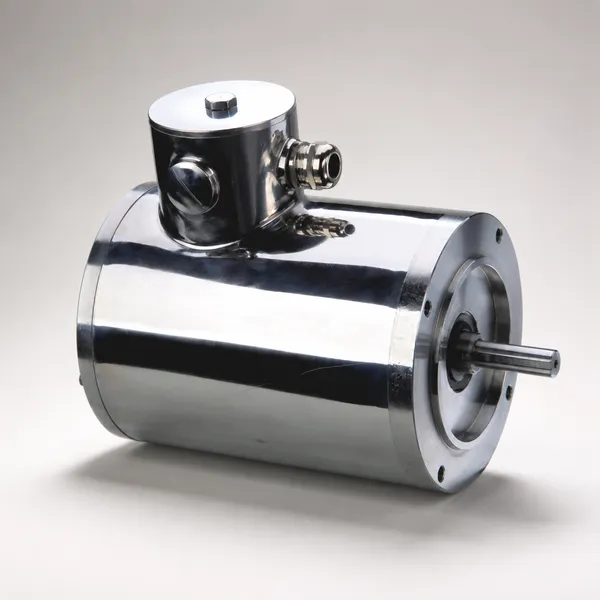
The Korea Ever-Power BXG series is the dedicated food-grade stainless steel motor for meat and poultry processing applications. Every external component in contact with the processing environment — frame, cooling fins, end shields, fan cover, terminal box, shaft, all fasteners, and shaft seal — is manufactured from or coated with AISI 316L stainless steel, finished to Ra ≤ 0.8 μm as delivered. The BXG series uses the same squirrel-cage induction motor electrical design as the standard Y2 series, allowing direct performance substitution in any conveyor, portioning, or fan drive application. The full range is available in the stainless steel motor product section.
| Frame material | AISI 316L all external |
| IP rating | IP69K certified |
| Surface finish | Ra ≤ 0.8 μm |
| Shaft seals | FDA silicone (21 CFR 177.2600) |
| Bearing grease | NSF H1 food-grade |
| Insulation class | Class H (thermal shock) |
| Power range | 0.18–11 kW |
| Poles | 2P (2,850 rpm) / 4P (1,440 rpm) |
7. Application Areas in Meat and Poultry Plants
Slaughter Line and Evisceration Conveyor
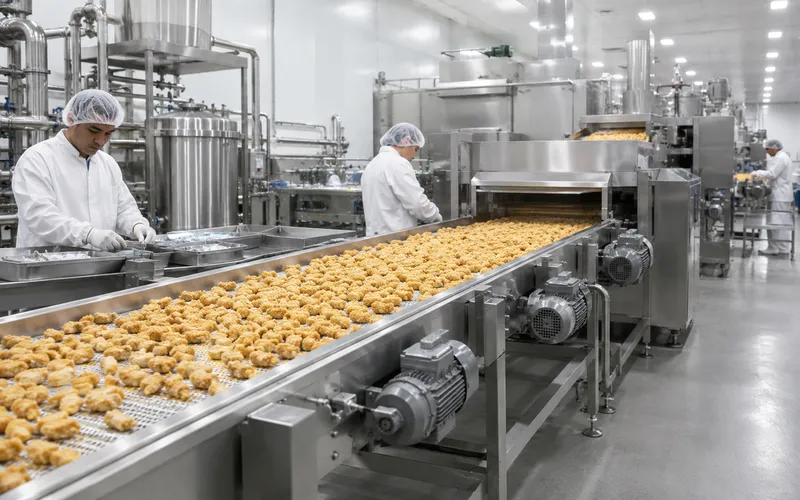
Overhead conveyor drives in the lairage, stun, bleed, and evisceration areas of beef, pork, and poultry slaughter plants are exposed to blood, ingesta, and high-pressure hot water washdown at the end of every production run. BXG 4-pole 0.37 to 2.2 kW motors drive the overhead rail conveyors and chain trolley systems through NMRV worm gearmotors. Every motor above the blood channel, lairage floor, and evisceration line must be IP69K stainless — these are the most heavily regulated areas of the facility and are inspected at every USDA/FSIS or EU approval audit. |

Cut Room and Deboning Line Conveyor
Deboning table conveyors, grading belt drives, and portioning line transfers in the cut room operate at slow speeds (0.05 to 0.2 m/s) with frequent starts and stops. BXG 4-pole 0.37 to 1.5 kW motors paired with NMRV 050–075 worm gearmotors provide the required low output speeds. The cut room operates at 2 to 7°C — Class H insulation in the BXG is important because thermal cycling from cold ambient to hot CIP washing creates mechanical stress on winding insulation that Class F motors may not withstand reliably over a 10-year service life. |
Evaporator coil fans in chiller rooms operate continuously at –2 to 4°C with periodic defrost cycles at 20 to 40°C. BXG 2-pole fans are subject to condensation, ice formation, and weekly defrost washdown. IP69K and Class H insulation for thermal cycling are both required.
Meat tumbler and marination drum drives in the further processing area use BXG 4-pole or 6-pole 0.75 to 5.5 kW motors at slow agitation speeds. Tumbler areas are subject to spilled marinade (acidic, high-salt, sometimes chilli-containing) and daily washdown.
Tray sealer infeed conveyors, thermoform packaging machine drives, and case erector drives in the primary packaging area require IP69K motors if they are in the open product zone. BXG 0.18 to 1.5 kW 4-pole units cover the range of packaging line conveyor and machine drives.
Offal collection conveyors, blood channel pumps, and tripe washing line drives in the by-product area are among the most aggressive motor environments in any meat plant — high acid content from gut contents, very high-frequency washdown, and strong caustic cleaning at high concentration. BXG IP69K SS316L is mandatory in these areas.
8. Frequently Asked Questions
Edited by Cxm